


Institutional cryptocurrency portfolios are expanding beyond Bitcoin and Ethereum, with Coinbase and EY-Parthenon survey data showing that 25% of respondents plan to add XRP to their allocations in 2026. The same report shows that the share of companies holding any cryptocurrencies other than Bitcoin or ETH rises from 51% to 56%, indicating a broader institutional shift to select altcoins rather than a simple two-asset market.
the Results These findings come from a January 2026 survey of 351 global corporate decision-makers, 96% of whom represent companies with more than $1 billion in assets under management. The participant base was 60% from the US, 20% from Europe including the UK, and 20% from the rest of the world, covering asset managers, hedge funds, private banks, venture funds, asset owners and family offices. Across this group, 73% said they plan to increase digital asset allocations in 2026, while 74% expect cryptocurrency prices to rise over the next 12 months.
XRP among 2026’s top picks
Bitcoin and Ethereum still dominate the institutional landscape, but the diversification trend is evident in the report’s breakdown of current and planned allocations. Bitcoin appears in 94% of current institutional cryptocurrency allocations and 91% of 2026 plans, while Ethereum’s share rises from 86% to 90%. Outside of the two largest assets, Solana’s share moved from 36% to 38%, Chainlink from 20% to 26%, XRP from 18% to 25%, Binance Coin from 12% to 15%, Cardano from 4% to 5%, Tron from 3% to 4%, and Bitcoin Cash from 3% to 6%. Dogecoin remains marginal at 2% both currently and in 2026 plans.
The XRP number is important in part because it falls within a broader expansion in institutional size. Among companies already investing in digital assets, the share that allocates more than 5% of assets under management to this category is expected to rise from 18% to 29% by the end of 2026. The allocation group from 6% to 10% rises from 11% to 19%, and the allocation group from 11% to 20% rises from 3% to 7%. At the same time, access remains heavily skewed toward regulated wrappers: 66% of digital asset investors now have exposure through ETFs or ETFs, 81% prefer immediate exposure via a registered vehicle, and net spot cryptocurrency ownership via ETFs, ETFs, or direct holdings rose from 76% in January 2025 to 79% in January 2026.
This combination of broader asset selection and more rigorous portfolio construction runs throughout the report. Of those who plan to increase their holdings, 65% reported Greater organizational clarity and trust in compliance frameworks as a key driver, 51% cited wider availability of digital assets in regulated vehicles, and 46% cited better availability Infrastructure at the institutional level across the nurserySettlement and risk.
Smaller companies were the most aggressive, with 77% of the $1 billion to $50 billion group of assets under management planning to increase or significantly increase holdings, versus 69% of companies in the $51 billion to $500 billion range and 64% of the $501 billion to $1 trillion group.
However, institutions are not approaching the market with more flexible standards. The survey found that 49% said recent volatility had enhanced their focus on risk management, liquidity and position sizing, while 22% said volatility had caused them to slow down, delay or keep allocations conservative. Regulation remains both a driver and a barrier: 78% of respondents said market structure was the area most in need of clarity, with 66% still citing it Regulatory uncertainty As a major concern when investing in digital assets.
At press time, XRP was trading at $1.37.
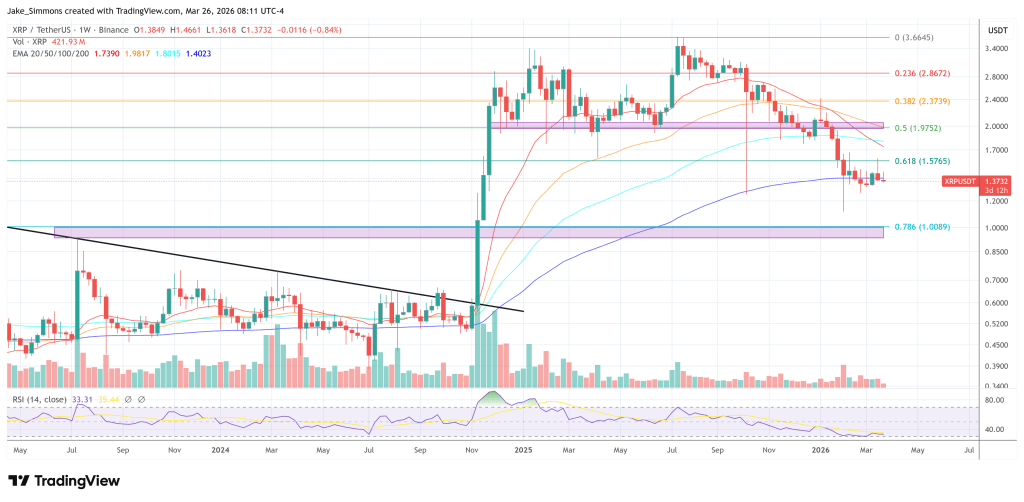
Featured image created with DALL.E, a chart from TradingView.com
Editing process Bitcoinist focuses on providing well-researched, accurate, and unbiased content. We adhere to strict sourcing standards, and every page is carefully reviewed by our team of senior technology experts and experienced editors. This process ensures the integrity, relevance, and value of our content to our readers.



