

Bitcoin fell -3% to $63,100 on July 28, an 11-day low, as traders assigned a roughly one in three chance of a surprise Fed rate hike at the July 29 FOMC meeting.
This would exacerbate a crypto sell-off that has already soured with more than $465 million in outflows from US Bitcoin ETFs recorded on July 23 and 24, in addition to yesterday’s (July 27) modest outflow of $11 million.
This is not just a Bitcoin-specific repricing. It is a macro-de-risking event where price expectations are the effective variable, and ETF flow data confirms that institutional participants moved first.
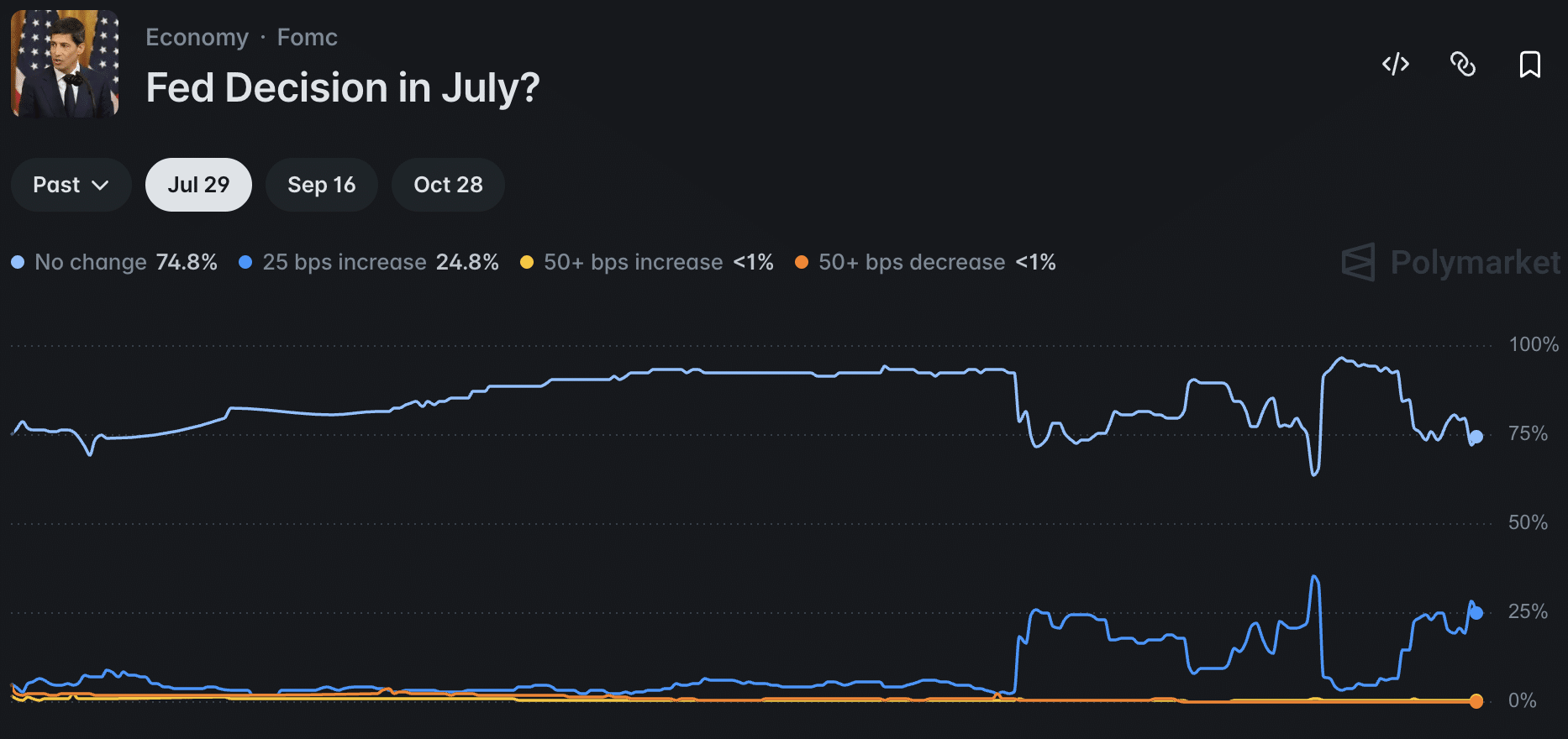
Mechanics of the Fed Rate Decision: How the Potential of a Bitcoin Rate Rate Moves the Bitcoin Price
The mechanism works as follows: Rising interest rate expectations increase the opportunity cost of holding risky non-return assets, prompting systematic and discretionary managers to reduce exposure ahead of the FOMC decision.
Citadel Securities expects a 25 basis point rate hike on July 29, describing it as a move that would bolster Fed Chairman Kevin Warsh’s credibility in fighting inflation – a framework that, even if a rise does not materialize, anchors an upbeat reading for the meeting.
The ETF outflow number is the clear signal of institutional conviction. The $465 million in outflows during July 23-24 snapped a seven-session streak of inflows that provided much of the price support during Bitcoin’s modest recovery in July.
This recovery itself has been fragile: Bitcoin was recovering from a nearly 50% collapse from its October 2025 all-time high of $126,000, and the $65,000-$65,500 resistance band had capped multiple upside attempts before this week’s decline.
Concerns about raising interest rates also overshadow recent legislative momentum. The Clarity Act, a long-awaited bill to structure the US cryptocurrency market, provided a degree of positive sentiment through mid-July, but these tailwinds were neutralized by a macro repricing ahead of the FOMC meeting.
$ Bitcoin It failed to maintain the $65,000 level.
This happened when the Senate suspended the Clarity Act.
Now, the next major support level for Bitcoin is $62,000 – $65,000.
This should continue, otherwise BTC will end up giving all the gains. pic.twitter.com/CVFjOqdY4Q
– Ted (@TedPillows) July 28, 2026
Analyst positioning: key levels and 200-day moving average threshold
Carolyn Morrone, co-founder of Orbit Markets, said Bitcoin has been “primarily hit by the growing likelihood of a Fed hike, as well as macro concerns about AI-related credit risks,” and identified $62,000 as the next bearish level to watch, with strong support expected around $60,000.
Both thresholds lie below the current spot rate and represent near-term market stress testing areas if the FOMC achieves the surge predicted by Citadel Securities.
Tony Sycamore, an analyst at IG Australia, described the current stance as a neutral bias for Bitcoin, noting that a sustained breakout and close above the 200-day moving average at $72,001 is still required to negate medium-term downside risks and allow a more positive technical picture to emerge.
This level is approximately 13.5% above the intraday low on July 28, a gap that underscores how much structural repair remains before trend-following buyers return to volume.
The dynamics on the string add another layer to the structural reading. The wider drawdown from the $126,000 peak was accompanied by capitulation by long-term coin holders and accelerated coin movement to exchanges, patterns consistent with forced selling rather than discretionary selling, as detailed in CoinSpeaker’s analysis of long-term Bitcoin holder behavior during Bitcoin’s decline.
discovers: Best coins to buy in 2026
Framing a bull and bear scenario: What does the FOMC decision change?
Reminder: 🇺🇸 The FOMC decision is tomorrow, and every serious investor should watch it.
Price decision: 2:00 PM ET
Kevin Warsh Press Conference: 2:30 p.m. ETMarkets are pricing in a roughly 40% chance of a surprise raise.
A single decision can move stocks, cryptocurrencies, bonds and the dollar simultaneously. https://t.co/zooN8GEt1a pic.twitter.com/kpeLEUDNrN
— Crypto Rover (@cryptorover) July 28, 2026
The confirmatory requirement for stabilization is clear: a Fed stay coupled with dovish language would remove major headwinds and allow interest to return to the law of clarity and immediate demand for ETFs. In this scenario, the $65,000-$65,500 resistance band becomes the near-term target for any recovery attempt.
The downward path passes through Moron support levels. A confirmed rate hike of 25 basis points will likely accelerate ETF flows beyond the July 23-24 pace, raising the possibility of a test of $60,000, a rough figure level that has historically attracted retail buyers and options market activity.
We believe that the P&L spread at this level, which is heavily skewed towards post-$100k correction buyers, makes a clean break below $60k structurally difficult without a secondary macro shock.
The analytical question is no longer whether or not Bitcoin is in a medium-term downtrend, but rather the 200-day moving average gap is settling that. It comes down to whether the results of the July 29 FOMC meeting will lead to another wave of ETF redemptions or give July’s fragile recovery enough room to resume.
explores: Best Meme Coins You Can Buy for August
Disclaimer: Coinspeaker is committed to providing unbiased and transparent reporting. This article aims to provide accurate and timely information but should not be considered financial or investment advice. Since market conditions can change rapidly, we encourage you to verify the information yourself and consult with a professional before making any decisions based on this content.

Daniel Francis is a technical writer and Web3 educator specializing in macroeconomics and DeFi mechanics. A crypto native since 2017, Daniel brings his background in cross-chain analytics to author evidence-based reports and detailed guides. It holds certifications from the Blockchain Council and is dedicated to providing “information gain” that cuts through the market noise to find blockchain’s real-world utility.



