
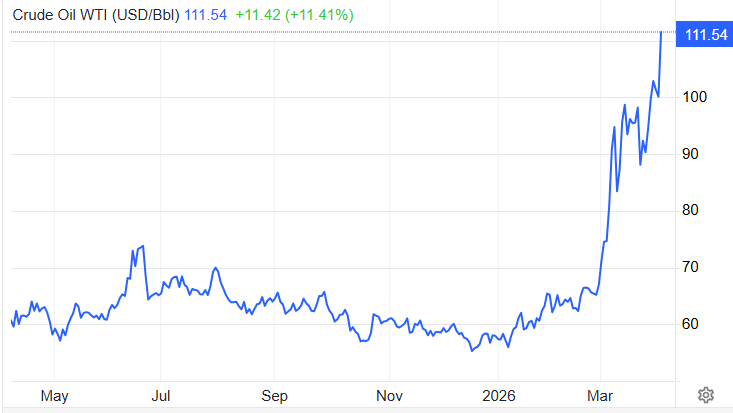
As the US-Iran war entered its thirty-sixth day, global oil prices rose to exceed $111, an increase of more than 11%. This sudden rise in crude oil prices is due to increased concerns about the security of major maritime trade routes. In the wake of the closure of the Strait of Hormuz, markets are now bracing for potential disruptions in the Bab al-Mandab Strait.
Oil prices rise as Bab al-Mandab risks increase
Amid rising tensions in the Middle East, the focus is now shifting from the Strait of Hormuz to another crucial route: the Bab al-Mandab Strait. Final warning to Iran He points out that the unrest could extend beyond the Arabian Gulf region, threatening global energy and trade.
Amid this speculation, oil prices rose by more than 11%, reaching $111. Last day, it witnessed the largest daily rise in prices in six years. Commenting on the real risk of the rally, Amrita Sen, founder of Energy Aspects, said: “You see it but the financial market is almost masking the real distress that is showing everywhere else.”
Nearly 20% of the world’s oil passes through the Strait of Hormuz. Its partial closure has already tightened supplies and increased shipping costs. Recently, Bitcoin has declined, and Oil prices rose sharply After Russia, China and France used their veto power against a UN Security Council resolution, with the support of Arab countries, to allow the use of force to reopen the Strait of Hormuz.
Now, the possibility of a malfunction at Bab el-Mandab has become a subject of speculation as any malfunction will result in ships having to divert to the Cape of Good Hope route. This may add 10 to 15 days to travel time, increasing the cost of transporting oil, food products and other goods around the world. He – she This could lead to global oil prices rising, leading to more global inflation.
Iran signals possible disruption to main shipping route
Muhammad Baqir Qalibaf, Speaker of the Iranian Parliament, indirectly threatened the possibility of closing Bab al-Mandab. He read his statement,
“What is the share of global oil, LNG, wheat, rice and fertilizer shipments that transit the Bab al-Mandab Strait? Which countries and companies account for the highest transit volumes through the Strait?”
It is worth noting that Bab al-Mandab connects the Red Sea to the Gulf of Aden and the Suez Canal. About 6 million barrels of oil and 12% of global trade pass through this narrow waterway daily. If this road is closed, it could put global markets under pressure.
While Bitcoin and other cryptocurrencies are still facing losses amid the ongoing war between the US and Iran, the latest development has added more pressure on digital assets. As experts predict, if this geopolitical pressure continues, Bitcoin could fall to a sharp low Worth 10 thousand dollars.
Recently, BTC has seen a sudden decline Trump hinted at launching severe attacks against Iran. Traders and businesses are on high alert as the situation develops. High oil prices may lead to higher fuel bills, increased cost of goods, and increased pressure on household budgets.



