

Solana’s DeFi ecosystem is under siege, and the threat isn’t a vulnerability in the code. It is a nation state. Within eight days, North Korean agents allegedly drained $285 million from Drift Protocol and inserted a suspected client inside the separate Solana exchange as its chief technology officer. Price data remains clouded by the turmoil, but the security narrative surrounding SOL USD is deteriorating faster than any level of the chart can capture.
Solana-based decentralized exchange Stabble urged users to immediately withdraw liquidity on Tuesday after a pseudonymous on-chain investigator, ZachXBT, identified the protocol’s former CTO, operating under the name Keisuke Watanabe, as an alleged North Korean hacker.
Our latest update:
We can confirm now even one year ago we had a NK developer on the team.
He was supported by other North Koreans who supported his work. We thank you @derparsel and @zachxbt For their work.Historically, we’ve done audits with Sec3 and neodyme – everything looked…
– Stable (@stabbleorg) April 8, 2026
The protocol, which was recently handed over to a new management team, began today with a total value of approximately US$1.75 million, but an emergency alert triggered 62% TVL collapses to below $663,000According to DeFiLlama data. “emergency!” The new team Published on X. “Guys, please temporarily withdraw liquidity immediately! Better safe than sorry.” No exploit has been detected, but the company has confirmed it is conducting security audits.
The Stabble incident does not stand alone. He follows $285 million Drift Protocol hack on April 1, It has been confirmed by TRM Labs, Elliptic, and Chainasis as a North Korean operation, which now ranks as the largest DeFi exploit of 2026. This pattern raises a structural question that the market cannot ignore: Is Solana’s performance advantage being systematically weaponized against it?
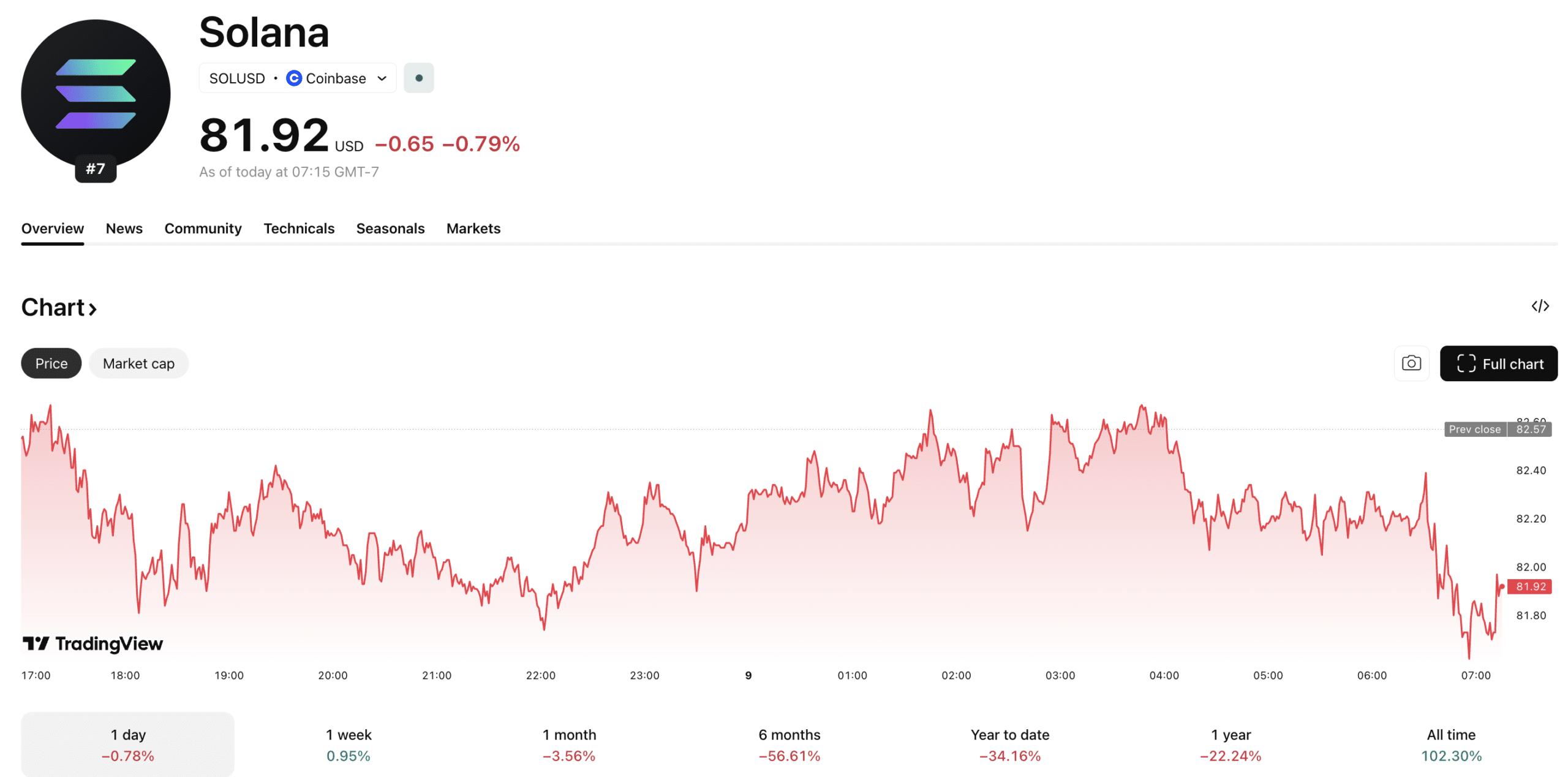
Can SOL USD survive two North Korean strikes in eight days?
Exact 24-hour SOL price figures are not available at the time of writing, but the on-chain data tells its own story. drift attack, It is executed in about 10 seconds Through social engineering, oracle manipulation, and pre-signed non-perpetual transactions, the stolen funds were converted to USDC and SOL before being transferred to Ethereum via CCTP. This conversion created direct and measurable selling pressure on SOL at a time when the broader cryptocurrency markets were already navigating macro uncertainty.
Technically, Solana faces a bearish scenario if further exploits or money-tracking operations by TRM Labs and Elliptic lead to an additional freeze on the exchange. The base case assumes containment: Solana Foundation Ecosystem Security Programs Already active, the transparency of the Stabble team arguably limited the infection this time around.
$ sol It is forming a bear flag and the collapse has already begun.
Last move: Consolidation → Breakdown → -54% Decline Now the same structure is repeated again.
If this continues, $ sol It could head towards the $45 area.
This is not a random price movement, but rather… pic.twitter.com/Aw92mJ2k8Z
— Crypto Lens (@crypto_lens_) April 9, 2026
The bullish status requires a clean audit result from Stabble and no new incidents linked to the DPRK, a condition that seems risky given that North Korea stole $2 billion in cryptocurrencies during 2025 alone, representing… Nearly 60% of global cryptocurrency hacks that year. The Drift exploit, second only to the $326 million wormhole breach in Solana’s history, has reset the ecosystem’s risk premium.
Elliptic described the Drift attack as a “continuation of the DPRK’s ongoing campaign” to fund weapons programs. This framing, the state adversary, not opportunistic hackers, changes the way investors should model risk based on Solana’s original positions.
discovers: Best cryptocurrencies to buy now
Bitcoin Hyper is positioned at the time where Solana speed meets Bitcoin-class security
The Stabble incident crystallizes the tension that had been quietly simmering: SOL USD offers speed, but that speed resides in infrastructure that has now been exposed to the human attack surface twice a week.
Bitcoin, for all its limitations, slow transactions, high fees, and limited programmability, has never suffered a similar nationwide hack of its underlying infrastructure. And this discrepancy is precisely the gap Bitcoin Hyper It is positioned to close.
Bitcoin Hyper describes itself as the first Bitcoin Layer 2 to integrate the Solana virtual machine, targeting sub-second end and low-cost smart contract execution while pinning security on Bitcoin’s core layer — the only chain that North Korean hackers clearly left alone.
The project has raised $32 million at the current selling price of $0.0136783, with staking bonuses available to the first participants. The main infrastructure includes a decentralized fiat bridge for BTC transfers and a high-speed SVM implementation, and Solana’s throughput is effectively anchored to Bitcoin’s trust model.
Visit Bitcoin Hyper Presale website is here.
explores: The best Solana Meme Coins you can buy right now
Disclaimer: Coinspeaker is committed to providing unbiased and transparent reporting. This article aims to provide accurate and timely information but should not be considered financial or investment advice. Since market conditions can change rapidly, we encourage you to verify the information yourself and consult with a professional before making any decisions based on this content.

Daniel Francis is a technical writer and Web3 educator specializing in macroeconomics and DeFi mechanics. A crypto native since 2017, Daniel brings his background in cross-chain analytics to author evidence-based reports and detailed guides. It is certified by the Blockchain Council and is dedicated to providing “information gain” that cuts through the market noise to find blockchain’s real-world utility.



