


Cardano founder Charles Hoskinson used one of the most confrontational videos in recent memory to argue that Bitcoin’s long-standing resistance to structural change has made it vulnerable to the quantum computing threat now emerging in the debate over BIP 361. His core claim was straightforward: Bitcoin’s governance culture, not just its cryptography, is now the problem.
in live feedTitled “BIP 361: Welcome to ShitcoinLand, Bitcoin,” Hoskinson framed the proposal as a belated acknowledgment from parts of the Bitcoin world that quantum risk is no longer theoretical. The Cardano founder pointed to language in the proposal that states that as of March 1, 2026, more than 34% of all bitcoins have exposed on-chain public keys, leaving those UTXOs vulnerable to theft by an attacker with a sufficiently powerful quantum computer. In his telling, this amounts to approximately 8 million Bitcoins vulnerable to future hacking at Bitcoin’s current signing assumptions.
BIP-361 proposes freezing every Bitcoin that is not migrated to a quantum safe address within five years of activation. If you are incapacitated, in prison, or simply unaware of the deadline, your coins will not be stolen. It was unanimously frozen.
Justification: 34% of the total… pic.twitter.com/4ValsZTdQD
– TFTC (@TFTC21) April 15, 2026
Cardano founder attacks Bitcoin developer community
Hoskinson’s attack focused on two related allegations. First, he said that the response was implied Pep 361 It will require a hard fork, even if described otherwise. Second, he said that any forced migration to post-quantum addresses would create a deeper problem for coins held in legacy wallet formats that cannot be recovered through the kind of proof system he says the proposal envisions.
“There is some truth here,” Hoskinson said. “As of March 1, 2026, more than 34% of all bitcoins have exposed their on-chain public key…these UTXOs could be stolen by an attacker with a sufficiently powerful quantum computer. 34% of all Bitcoin is at risk. About 8 million bitcoins, give or take.”
This is what formed the heart of his criticism. According to Hoskinson, Bitcoin developers are now stuck between two bad outcomes: either leaving vulnerable legacy currencies vulnerable to theft in the 2030s, or forcing a migration that makes a significant portion of legacy coins virtually unspendable. He has repeatedly claimed that about 1.7 million Bitcoins fall into this latter category, including nearly 1.1 million Bitcoins that he has attributed to it. Satoshi NakamotoBecause they predate the portfolio standards and seed phrase systems that would make later recovery models possible.
“Users with weak quantum frozen funds and a seed phrase for a high-precision wallet can create a quantum safe proof of refund,” he said, rephrasing the idea before dismissing it. “That’s a lie. And you know that. You know that. 1.7 million coins can’t do that. It’s not possible.”
Hoskinson then expanded the argument beyond BIP 361 itself and into a broader critique of Bitcoin’s social structure. In his view, extremist ideology has turned the software system into a dogma, making adaptation more difficult when technical trade-offs become inevitable. He argued that the industry has spent years rejecting alternative chains and governance models, only to reach a moment when Bitcoin may need exactly the kind of coordinated protocol change that has long been portrayed as unacceptable.
“What happened there would only be 21 million coins and self-incubation, Bitcoin would never need to change hands and everything would be fine?” he asked. “Because that’s the thing, it’s not a bad proposal. It’s really not. I understand why they wrote it. Because if they didn’t, that money would be stolen in the 2030s.”
This tension gave the video its structure. The Cardano founder was not arguing that the quantum threat is imaginary. Quite the opposite. He treated it as real and possibly intense. But he said the proposed remedy reveals a contradiction at the heart of Bitcoin culture: Once part of the supply is compromised, any meaningful reform runs straight into questions of expropriation, coordination and legitimacy.
He compared this to networks like Cardano, Polkadot, and Ethereum, arguing that formal governance systems at least provide a mechanism for resolving disputes over upgrades and swaps. “If you have onchain governance, you can solve it,” he said. “We have that in Cardano. Polkadot has that…it’s a good idea.”
At press time, Cardano was trading at $0.2499.
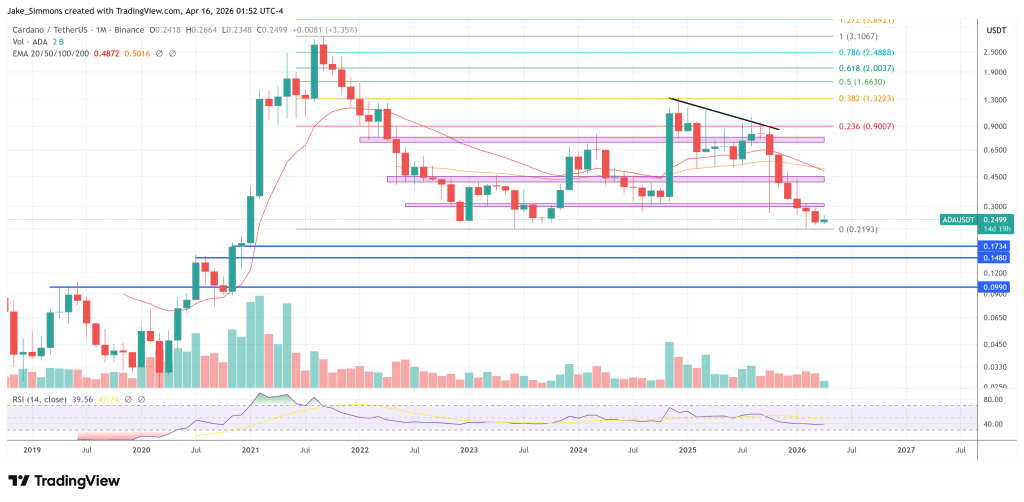
Featured image from YouTube, chart from TradingView.com
Editing process Bitcoinist focuses on providing well-researched, accurate, and unbiased content. We adhere to strict sourcing standards, and every page is carefully reviewed by our team of senior technology experts and experienced editors. This process ensures the integrity, relevance, and value of our content to our readers.



