

Ripple’s former CTO, David Schwartz, disputed the idea that he is a committed long-term holder of XRP, saying in a series of X posts that Ripple shares, not XRP, now represent his main exposure to the cryptocurrency sector.
Comments are important because Schwartz remains one of the most commented Personalities are closely watched In the XRP community. His statements led directly to the recurring tension around Ripple, XRP, and the difference between exposure to the company’s business and exposure to assets tied to the XRP Ledger.
The exchange was initiated after users reconsidered Schwartz’s previous decision to sell ETH at $1.05. In response to a post that viewed the sell-off as a missed opportunity, Schwartz said he didn’t see the upside potential as obvious at the time.
“If I thought there was a 1% chance of hitting $2,368, I wouldn’t sell it for $1.05,” he wrote. “I’m still not sure the odds of that happening were more than 1% at the time.”
This admission sparked a broader discussion about Schwartz’s current exposure to XRP. When asked if he still held XRP, he replied that he didn’t have “that kind of money anymore” and had tried to move most of his assets away from the risks of cryptocurrencies, with one major exception: Ripple stock.
“I fully realize that cryptocurrencies may be a once-in-a-generation opportunity to get rich that we haven’t missed yet, which may mean I’m missing out on a lot of it,” Schwartz wrote. “I’m okay with that, and I hope my Ripple stock gives me enough exposure. I sleep better at night that way.”
Ripple stocks as the primary exposure
Schwartz framed the decision as a matter of risk tolerance rather than a direct connection to the future price of XRP. He said he “didn’t really like to take risks,” although many of the risks he took were beneficial to him. In another post, I make this point more explicitly.
“I’m not a diamond hands guy. That’s not who I am. I’m a smart, sensible investment guy who might pass up great opportunities. And I’m OK with that.”
For XRP holders, the most important part of the exchange wasn’t that Schwartz said it held fewer XRP. His explanation was that Ripple shares already give him enough exposure to the same broad ecosystem. When asked if he would look at XRP differently if he had less inventory, Schwartz said he most likely would.
“Yes. I think I would hold more
This distinction is important. Schwartz did not say that XRP and Ripple stocks are the same trade. In fact, he argued the opposite when asked if Ripple could create a “XRP to Equity” scheme that would give long-term XRP holders priority access to shares if Ripple goes public.
He said the information he has about Ripple stock trading on the secondary market is covered by non-disclosure agreements, though he directed users toward platforms like Notic.co and Hiive for public data. But he was skeptical about directly linking XRP holders to the Ripple stock story.
“I personally am not a fan of Ripple trying to do something like this,” Schwartz wrote. “If people want exposure to Ripple’s gains and losses, they should buy Ripple shares on the secondary market. I don’t think it’s good for XRP for its value to become more intertwined with Ripple’s success or failure than it needs to be.”
The legal line between XRP and stocks
Schwartz also rejected the idea that the company could simply open access to shares to XRP holders. When one user argued that the company should allow the community to buy Ripple shares directly, he said there was “no practical way” to do so under current law.
“Ripple shares are undoubtedly a security,” he wrote. “If you want direct exposure to Ripple’s success or failure, you can buy Ripple shares on the secondary market if you qualify under US law. But you probably shouldn’t.”
He also described any future public listing of Ripple as speculative, citing uncertainty about the regulatory environment. A less favorable SEC in the future could become a major issue if Ripple does this, he said Going public in the United States.
The discussion later turned to Schwartz’s XRP allocation. When asked why he only had 26 million XRP while other early Ripple companies-The associated numbers received much larger sumsHe declined to review the full history but said he ended up owning “a significant amount of Ripple stock.” In another response, he clarified that the 26 million XRP was not a gift, saying it was the XRP he traded Bitcoin for.
“Once XRP hit 10 cents, millions of dollars were at risk,” he wrote. “I didn’t like it very much at the time.”
At press time, XRP was trading at $1.4071.
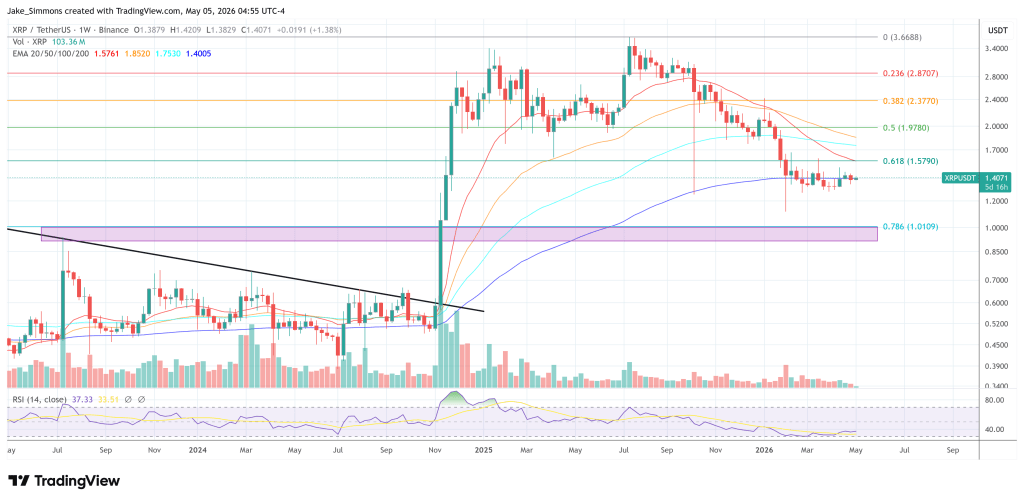
Featured image created with DALL.E, a chart from TradingView.com
Editing process Bitcoinist focuses on providing well-researched, accurate, and unbiased content. We adhere to strict sourcing standards, and every page is carefully reviewed by our team of senior technology experts and experienced editors. This process ensures the integrity, relevance, and value of our content to our readers.



