
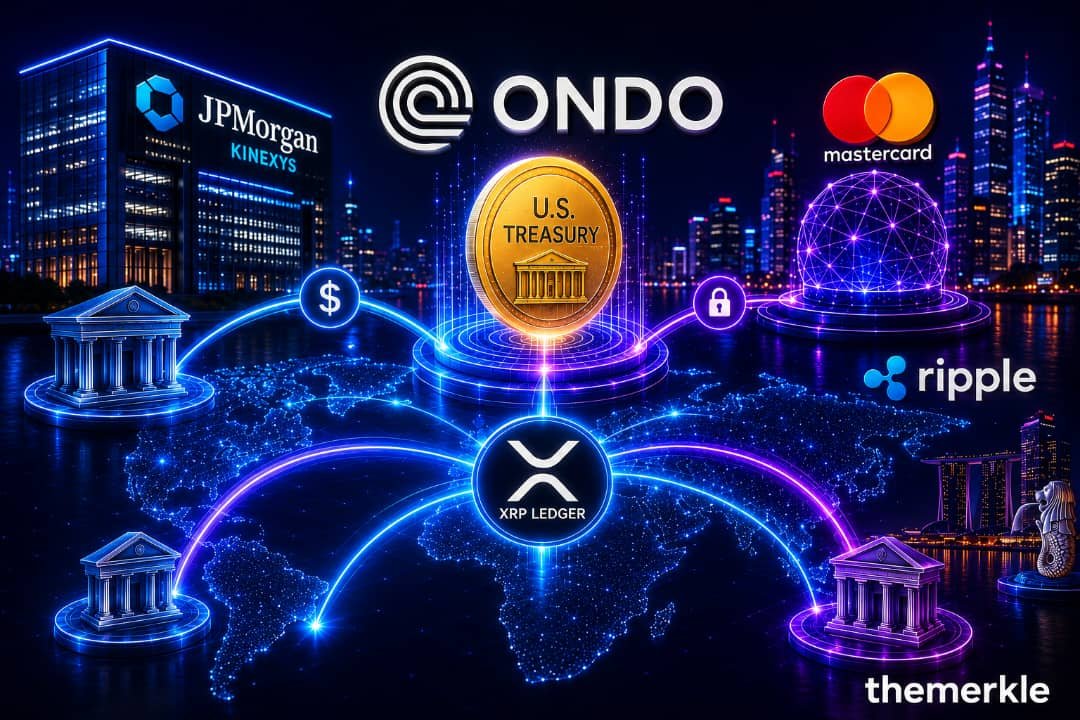
A crucial development is occurring at the intersection of legacy finance and blockchain Ondo Finance It partners with JPMorgan Chase, Mastercard, and Ripple to conduct a transaction between them.
It would connect the XRP Ledger directly to interbank settlement networks, a radical change in how global financial infrastructures interact.
The demo transaction is unique in that tokenized U.S. Treasury securities are settled internationally and between banks in near real-time, unhindered by traditional banking hours. This breakthrough is a game-changer in this regard with markets that can operate beyond the confines of time zones and institutional processing times. At the heart of this success is a workflow that interacts with multiple platforms.
On-chain Ondo Finance made a direct on-chain redemption of the U.S. Treasury token product (OUSG), taking advantage of the speed and transparency that blockchain systems provide us. This serves as a major proof of concept for the interaction of token assets in large-scale financial markets.
According to Ondo Finance’s announcement to the public, each participant in the transaction is assigned a role and highlights the ongoing synergy between blockchain innovation and traditional financial infrastructure.
Ondo, Kinexis by @jpmorgan, @MasterCard& @ripple Successfully completed a historic demo transaction linking the XRP ledger to interbank settlement rails.
This milestone marks the first time US Treasury tokens have been settled across borders and banks in near real-time… pic.twitter.com/BUjvWwHBGg
— Ondo Finance (@OndoFinance) May 6, 2026
Successful execution of a cross-border transaction
This was more than just a symbolic deal. Rather, it represented an effective, multi-layered financial infrastructure that worked to transfer real value across disparate networks. It started with Ondo Finance redeeming its token treasury product, OUSG, on the XRP Ledger to settle the transaction on the public blockchain.
Then, if it weren’t for Mastercard and its multi-token network acting as a routing layer to enable the secure and efficient routing of transaction instructions from Kinexys to JPMorgan’s blockchain-based settlement platform.
Kinexys, created by JPMorgan Chase, then moved to handling the traditional banking side of the transaction and settling the delivery in US dollars. This has ensured that the recovery generated by the blockchain is realized as liquidity in the banking system.
In the final stage, the funds were sent directly to the local account of Ripple Bank in Singapore, creating an elegant combination of decentralized blockchain infrastructure and centralized banking networks. This comprehensive implementation demonstrates how previously siled financial systems can work together as a seamless transaction pipeline.
Tokenized assets touch the overall financial infrastructure
If this development represents an inflection point for tokenized assets in general, the field has adopted more than a handful of institutions dedicated to tokenized US Treasuries over time. The experimental technology is beginning to move to real application in global finance.
The successful completion of this transaction demonstrated that token assets can now break free from the isolated ecosystems of blockchain technology. Rather than operating solely as a new type of asset class, they are progressing along the path to becoming integrated elements of the larger financial services infrastructure that can connect directly to banks, payment networks and cross-border settlement systems. The implications reach far beyond advances in speed and efficiency.
This process provides programmability and transparency that traditional systems could not scale instead of counterparty risk through tokenization. This pilot program validates these benefits in an actual financial environment, rather than just theory. In addition, the possibility of closing transactions during a holiday from regular banking services in FVO summarizes an important benefit of the blockchain infrastructure.
Whereas financial markets used to always close at the end of the business day, they can now operate 24/7, allowing a truly global economic system to exist at all times.
Industry leaders lay the foundation
No one can mistake the larger vision of this partnership: to create round-the-clock, decentralized financial markets freed from legacy systems. By combining the power of blockchain technology with existing banking infrastructure, companies participating in this effort are preparing themselves for a new era of financial connectivity.
The integration is beneficial for Ripple as it strengthens XRP Ledger’s position in institutional finance from a cross-border payments perspective. In parallel, Mastercard’s participation also signals a new level of evolving commitment from global payments networks to blockchain-based solutions.
The deployment of Kinexys at JPMorgan represents a continuation of its investments in blockchain in fintech to support modern financial infrastructure. The goal here is not to replace current systems, but rather to complement them and combine different old systems in addition to advanced technologies.
This pilot could serve as a guide for future collaborations, if other institutions look into such integrations. The success of this transaction confirms that the long-standing convergence between blockchain and traditional finance is no longer a future goal, but rather is unfolding, measurably, one transaction at a time.
Disclosure: This is not trading or investment advice. Always do your research before purchasing any cryptocurrency or investing in any services.
Follow us on Twitter @themerklehash To stay up to date on the latest Crypto, NFT, AI, Cybersecurity, and Metaverse news!



