

Polygon’s reputation as a reliable DeFi settlement layer is under renewed scrutiny after on-chain investigator ZachXBT reported an apparent exploit of the Polymarket UMA CTF converter contract, the mechanism that resolves market prediction results.
This latest hack on the most prominent prediction market platform has sent POL down nearly -1% in the past hour, with the token trading at around $0.091. However, depending on how deep the losses are, POL could still fall further.
The compounding incidents raise a more difficult structural question about Polygon’s status as the default settlement chain for high-profile prediction and derivatives platforms, and whether the network’s continued development roadmap is moving quickly enough to maintain that status.
warning: #polymarketIt appears that the contract has been exploited, and the attacker is stealing the funds.
So far, more than $660,000 has been stolen.
source: @zachxbthttps://t.co/WXvRwtWEFs pic.twitter.com/sIa0FWEEzo
– Loconchain (@loconchain) May 22, 2026
ZachXBT Reaction to Polymarket Hack: What’s the Harm?
The attacker’s address, 0x8F98075db5d6C620e8D420A8c516E2F2059d9B91, has since distributed the proceeds across 15 separate wallets, a pattern consistent with early-stage money laundering operations. What the final damage figure looks like and whether POL absorbs the hit to reputation remain questions that traders are watching.
According to ZachXBT’s public warning, attackers were draining approximately 5,000 POL every 30 seconds at the time of the warning, with confirmed losses reaching at least $520,000 and rising towards $600,000. The platform noted that the exploit specifically targets the UMA CTF converter, and not Polymarket’s underlying Polygon-based contracts, though this distinction may provide cold comfort to affected users.
This incident does not exist in isolation: Polymarket has separately confirmed account breaches linked to a third-party authentication provider, widely known to be Magic Labs, leaving a series of depleted USDC wallets across its user base. May has already recorded 19 DeFi hacks, with cumulative losses of about $38.2 million, according to Devilama datawhich is the context that frames this as a sector-wide stress test, not just a Polymarket issue.
ZachXBT: Suspected attack on Polymarket, the world’s largest prediction market
According to a ZachXBT community alert, Polymarket’s UMA CTF contract on the Polygon chain is suspected to have been attacked. The accident resulted in losses exceeding $520,000.
the… pic.twitter.com/CUw6qtWK8U
— Wu Blockchain (@WuBlockchain) May 22, 2026
Can POL price remain stable after Polymarket fallout?
What the on-chain evidence supports is a qualitative reading: a news exploit of this magnitude, draining hundreds of thousands of dollars from the leading Polygon app, historically produces short-term selling pressure on the host chain’s native token, followed by a rebound conditional on how quickly the protocol responds.
Polygon’s core infrastructure is not static. Giuliano’s final hard fork of the network targeted the finish speedwhich is a meaningful upgrade since settlement speed is key to the reliability of the prediction market. This catalyst may provide a technical footing for POL if sentiment stabilizes.
Three possible scenarios appear from here. On the upside, Polymarket’s $5 million Cantina bug bounty program, which covers critical vulnerabilities in smart contracts, is moving quickly to identify and remediate the adapter flaw, restoring confidence and allowing POL to recover losses within days.
Polymarket’s UMA CTF converter exploited on Polygon — attacker drains 5,000 $pol Every 30 seconds, more than $520,000 is stolen so far (Santiment MCP + Claude):
⚖️ $a Price reaction: $0.477 (07:00 UTC) → $0.462 (09:00 UTC), -3.3% as the exploit unfolds.
📊 $pol The price is the same… pic.twitter.com/KhcaeEK4BD– Santiment Intelligence (@SantimentData) May 22, 2026
The base case sees Polygon trading sideways while the investigation continues, with institutional participants monitoring repayment obligations before re-engaging. The case for a downturn (and the level of invalidation of any hypothesis of a near-term recovery) is straightforward: if total losses exceed the announced figures, or if additional contracts prove to be at risk, renewed selling pressure becomes the path of least resistance.
It is also worth asking if the platform has left some user accounts with it Balances as low as $0.01 After unauthorized access, it can credibly claim that its non-custodial design is sound. Polymarket has faced regulatory and legal scrutiny before This security ring adds a new operational layer to this pressure.
Bitcoin Hyper targets early bull move as Polygon tests credibility
Fatigue exploitation is real. When the main application of a leading DeFi chain suffers cascading security incidents, smart contract drains, and authentication breaches in the same cycle, some capital inevitably moves toward infrastructure operations that are perceived as less vulnerable. This rotation has historically benefited early-stage projects built at the protocol layer rather than the application layer.
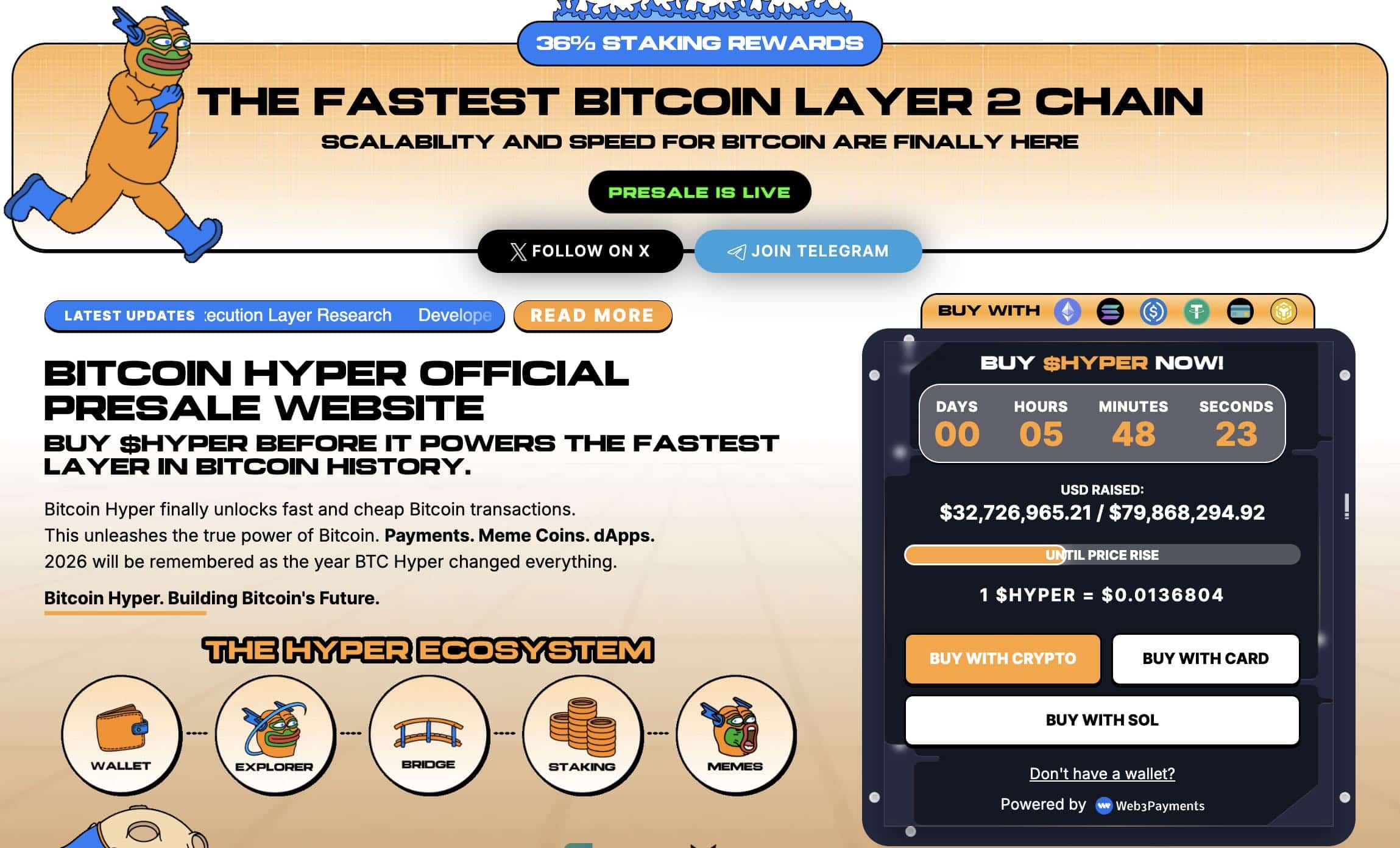
Bitcoin Hyper ($HYPER) It positions itself at exactly this intersection: Bitcoin Layer 2 that integrates the Solana virtual machine, designed to bring fast execution of smart contracts to Bitcoin’s security base without the custodial swaps that seem to haunt the Polymarket architecture.
The pre-sale has raised $32,726,397.59 at the current token price of $0.0136804, with staking bonuses available for early participants. SVM integration is the main technical claim; The sub-second end on top of Bitcoin’s trust model is supply. For investors looking for exposure to the infrastructure layer ahead of a potential Bitcoin ecosystem cycle, the project is worth examining.
Visit the Bitcoin Hyper Presale website here.
Disclaimer: Coinspeaker is committed to providing unbiased and transparent reporting. This article aims to provide accurate and timely information but should not be considered financial or investment advice. Since market conditions can change rapidly, we encourage you to verify the information yourself and consult with a professional before making any decisions based on this content.

Daniel Francis is a technical writer and Web3 educator specializing in macroeconomics and DeFi mechanics. A crypto native since 2017, Daniel brings his background in cross-chain analytics to author evidence-based reports and detailed guides. It is certified by the Blockchain Council and is dedicated to providing “information gain” that cuts through the market noise to find blockchain’s real-world utility.



