


A new amendment proposal has been submitted to the XRP Ledger Foundation storehouse On May 26, the redesign will fundamentally redesign how liquidity pools operate on the
The proposal, titled AMM Swappable Curves and Designated XLS Discussion #547, was submitted by Denis Angell (@dangel7) and Roman Thpt (@RomThpt) — both active contributors to the XRPL database — and is currently in draft status awaiting community review, according to a GitHub discussion thread. It is based directly on the XLS-30, a modification that introduced the original automated market maker for XRPL in 2024.
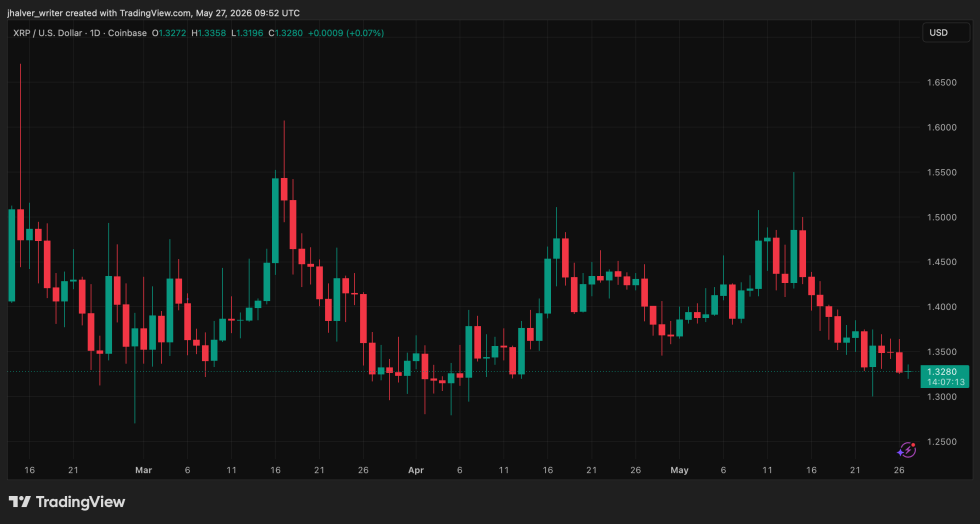
XRP's price moving sideways on the daily chart. Source: XRPUSD on Tradingview
The problem that the proposal solves
The current XRP Ledger AMM operates on one constant: the fixed product formula – the same model used by Uniswap v2, where liquidity is spread uniformly across all price ranges. The proposal identifies three structural gaps that limit the competitiveness of the current system.
The first is capital inefficiency. Uniformly distributing liquidity means that only a small percentage is active near the current market price – making it less attractive to liquidity providers than concentrated alternatives. The second is the inelasticity of the curve. Volatile trading pairs benefit from fixed product combinations. Stablecoin pairs benefit from StableSwap curves, which reduce slippage between closely linked assets. Pairs with long tails or asymmetric weights benefit from a balanced weighting approach.
Forcing all pairs into a single model is a structural flaw, according to the proposal. The third is composition. The XRPL payment engine already cycles through AMM pools and its own native order book – adding curve diversity doubles the available liquidity sources without requiring changes to the existing path selection logic.
What the amendment will provide
The proposal introduces a pluggable curve structure – where pool creators choose their preferred curve type at build time from an initial set of three. Curve 0 is the current fixed product model, maintaining full compatibility with all existing XLS-30 kits. Curve 1 is concentrated liquidity – equivalent to Uniswap v3 – allowing liquidity providers to target specific price ranges to dramatically increase capital efficiency. Curve 2 is StableSwap – equivalent to Curve Finance v1 – which is optimized for stablecoins and linked asset pairs where minimal slippage is most important, according to the proposal specifications.
The fourth type of curve – Smart AMM – is reserved for upcoming companion specifications. It will allow pool builders to deploy WebAssembly binaries that provide fully custom swap mathematics, dynamic fees, and lifecycle hooks including pre- and post-swap, deposit and withdrawal events. The architecture intentionally mirrors the host and sandbox ABI model already developed for the XLS-100 Smart Escrows — meaning the WASM runtime infrastructure is built once and reused across multiple XRPL features, according to the proposal.
Why does XRP matter?
Multiple pools for each pair of tokens – one for each curve type – will operate simultaneously without affecting existing pools. XRPL’s payment engine will route through all of them automatically, identifying the optimal liquidity source for each transaction without any changes required from end users or existing integrations, according to technical specifications.
This development represents a pivotal moment for XRP Ledger’s DeFi infrastructure. The protocol, which already hosts over $2 billion in real-world token assets and processes $1.93 billion in monthly transfers of stablecoins gaining Uniswap v3-grade concentrated liquidity and Curve Finance-style stable pools, will represent a meaningful step toward institutional-grade on-chain liquidity — exactly the infrastructure that the asset managers, banks, and stablecoin issuers currently relying on XRPL will eventually require.
Cover image of Grok and XRPUSD chart from Tradingview
Editing process Bitcoinist focuses on providing well-researched, accurate, and unbiased content. We adhere to strict sourcing standards, and every page is carefully reviewed by our team of senior technology experts and experienced editors. This process ensures the integrity, relevance, and value of our content to our readers.



