

Ripple filed two trademark applications on May 15, 2026, with the US Patent and Trademark Office for various financial services related to DeFi, including decentralized exchanges and prime brokerages, under its corporate brand and XRP.
The move signals a strategic position across institutional finance, leveraging Ripple’s existing custody, treasury, stablecoin and brokerage capabilities.
The timing suggests a deliberate effort to create a branding layer on top of infrastructure that already generates revenue, signaling the upcoming creation of a DeFi application layer on XRPL.
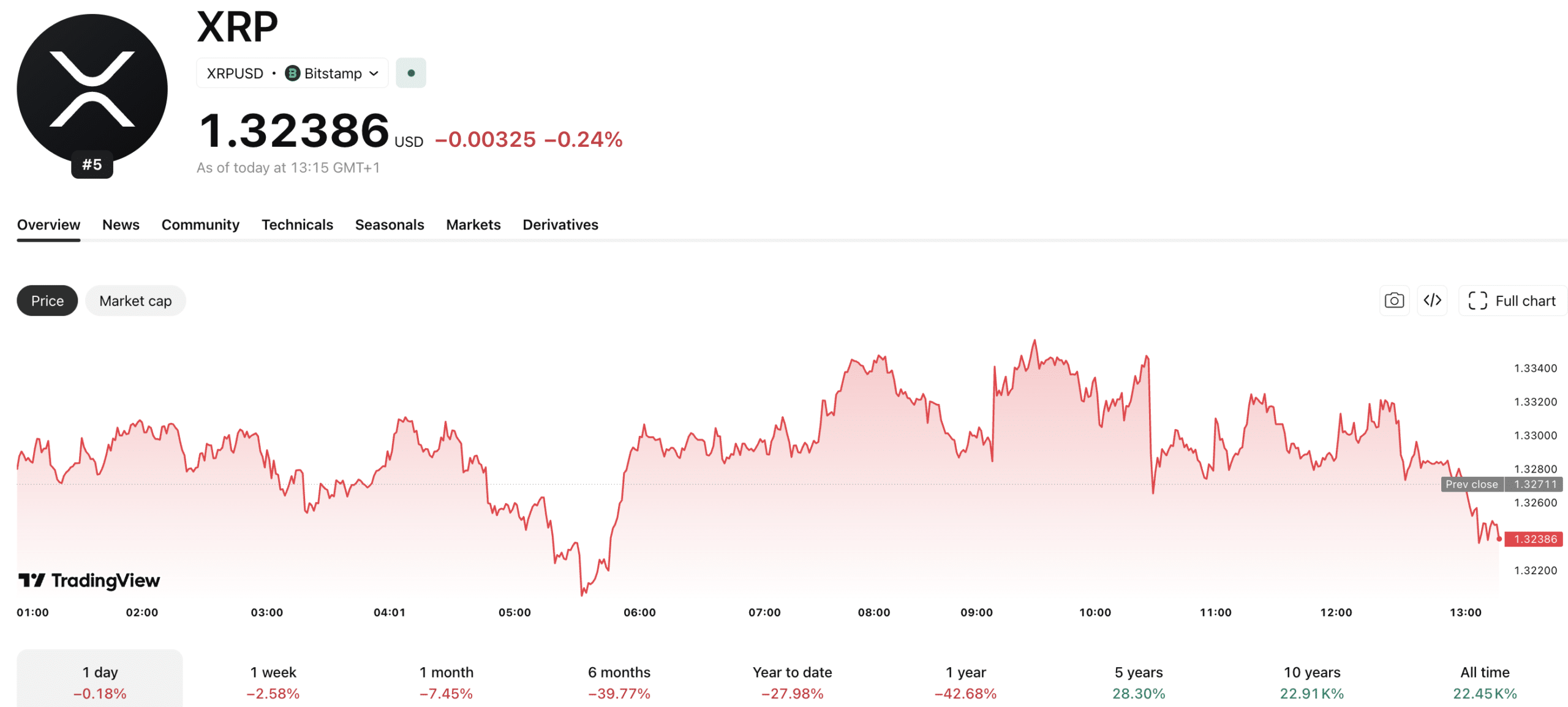
This news came as XRP USD fell by almost -2% overnight, falling to $1.33, accompanied by a decline in 24-hour trading volume to $1.56 billion, down from over $2 billion the previous day.
$XRP I just printed the 20/50 EMA Deathcross for two weeks.
This means: If we do not pull back soon, even if we see a rise to the EMAs ($1.70), we are still under severe macro resistance.
Above 20/50 = uptrend ✅️
Below 20/50 = downtrend ✅️No need to get overly complicated. pic.twitter.com/tusGpNu8FC
— 🇬🇧 ChartNerd 📊 (@ChartNerdTA) May 26, 2026
XRPL DeFi and New Brands: How the Mechanism Actually Works
XRP Ledger has had a native DEX platform since 2012, but interest spiked with the introduction of the XLS-30d mod, which enables automated market maker (AMM) protocols and on-chain liquidity pools, key elements of decentralized finance on platforms like Ethereum and Solana.
Ripple’s recent trademark filings expand its brand to include decentralized trading, AMM operations and virtual currency liquidity management, in line with XRPL’s existing infrastructure.
David Schwartz, Ripple’s CTO, emphasized that AMM integration is key to increasing DeFi activity on XRPL, especially for institutional use cases, a theory supported by many analysts in the space.
Unlike public DeFi protocols, Ripple’s institutional DEX aims to offer a compliance-oriented access layer that adheres to KYC and AML requirements, which could attract large financial institutions to participate in DeFi.
Vertical integration and competitive positioning: What filings reveal about Ripple’s corporate strategy
Ripple is rapidly building an integrated financial institution. In 2025, it acquired Hidden Road for $1.25 billion, and renamed it Ripple Prime, making it the first cryptocurrency company to have a global multi-asset prime broker clearing over $3 trillion annually to over 300 institutional clients.
Additionally, the Office of the Comptroller of the Currency conditionally approved the National Trust Bank for Ripple, placing RLUSD reserve management under federal oversight, a critical step for institutional purchases.
Ripple also owns treasury software company GTreasury and digital asset custody company Metaco, creating an end-to-end financial infrastructure. The successful cross-border redemption of US Treasury tokens on the XRP Ledger in May 2026 by JPMorgan, Mastercard and Ondo Finance highlights institutional-level use cases on the Ripple platform.
The recent trademark filings likely indicate Ripple’s intention to create a branded institutional DEX platform, positioning itself as a regulated access point to XRPL’s DeFi layer. However, it is important to note that trademark registrations do not equate to product launches, and Ripple has not yet confirmed a timeline for the DEX interface.
discovers: Best coins to buy in 2026
Implications of the Ripple XRP Token: Structural Potential vs. Clear Order Flow
XRP could create the next “crypto millionaires.”$XRP They could create new millionaires and even new billionaires in the coming years, says Cryptocurrency commentator Remi Relief.
He said XRP could eventually rise toward the $1,200 to $1,700 range under a scenario of major global financial expansion. pic.twitter.com/HFJPAA8QyY
-BSCN (@BSCNews) May 27, 2026
The main question for XRP holders is whether DeFi growth on XRPL creates permanent demand for the token. Currently, Ripple Prime’s revenue has tripled while the price of XRP has dropped from over $2.00 to around $1.33.
This difference shows that, as a private company, Ripple’s profits go to shareholders rather than XRP holders, as all revenues are recorded on Ripple’s balance sheet.
The bullish case for XRP hinges on its integration into a DEX-branded exchange, potentially using XRP as a liquidity pair, which could create buying pressure. Conversely, the base case suggests that most institutional volume is based on RLUSD and fiat channels, limiting the expansion of XRP facilities.
The bearish outlook suggests that institutional DeFi on XRPL may primarily include RLUSD and tokenized assets, leaving XRP with structural potential rather than active use.
Ripple’s CEO is open to acquisitions that could improve the infrastructure, but this does not address the utility of XRP, and a product launch would be needed to validate demand.
explores: Cryptocurrency hack alerts this week
Disclaimer: Coinspeaker is committed to providing unbiased and transparent reporting. This article aims to provide accurate and timely information but should not be considered financial or investment advice. Since market conditions can change rapidly, we encourage you to verify the information yourself and consult with a professional before making any decisions based on this content.

Daniel Francis is a technical writer and Web3 educator specializing in macroeconomics and DeFi mechanics. A crypto native since 2017, Daniel brings his background in cross-chain analytics to author evidence-based reports and detailed guides. It is certified by the Blockchain Council and is dedicated to providing “information gain” that cuts through the market noise to find blockchain’s real-world utility.



