

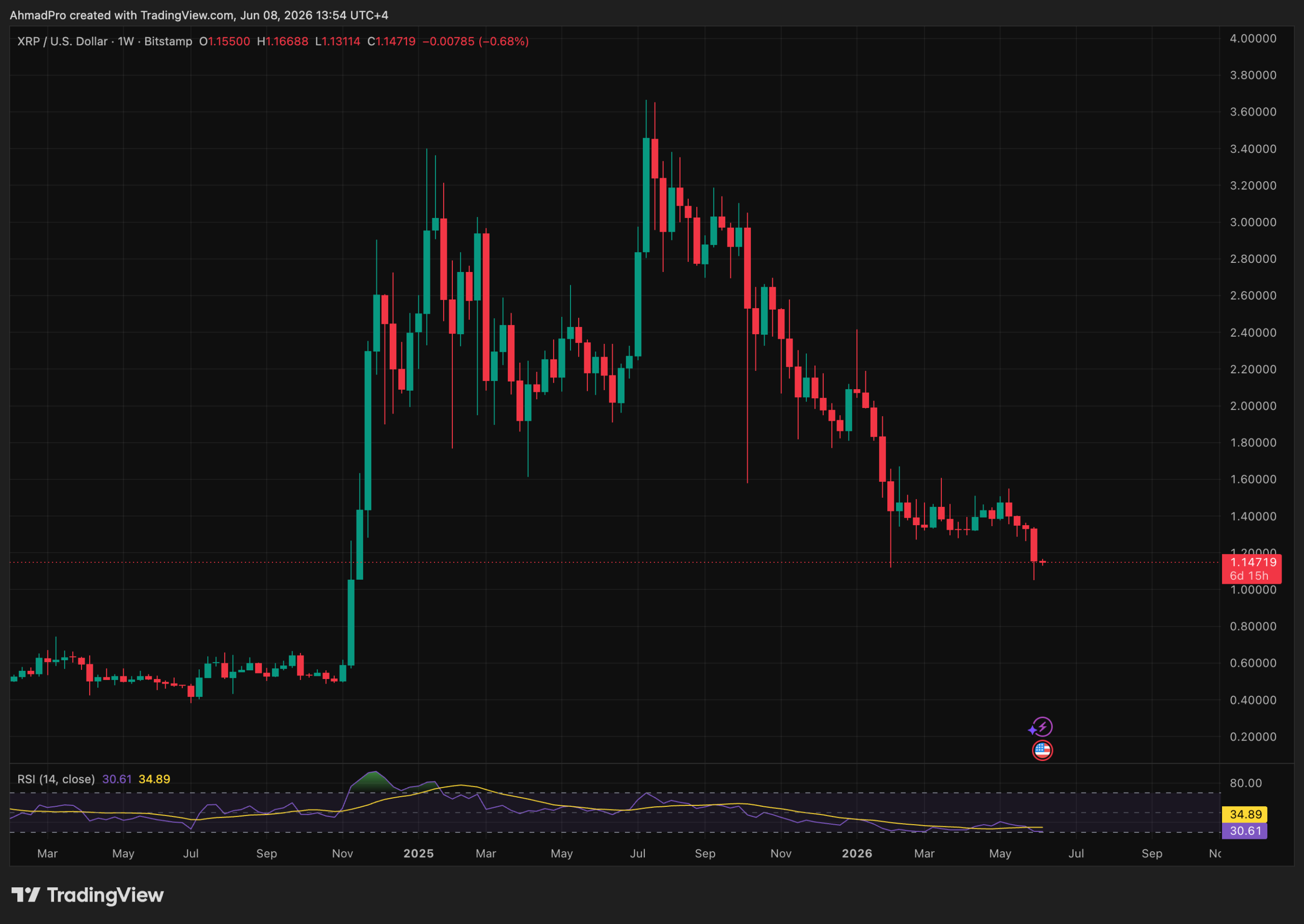
XRP printed $1.08 on June 5, 2026, its lowest level in 19 months, as stronger-than-expected US jobs news showing 172,000 new jobs ignited Fed interest rate concerns and sparked a cascade that wiped out more than $1 billion in leveraged cryptocurrency long positions within 24 hours.
Bitcoin fell to a weekend low of $59,100, and XRP fell with it, extending a decline that now stands at about 69% from the July 2025 cycle high of $3.65. The token has since stabilized in the $1.12-$1.16 range, recovering approximately 7% from Friday’s low.
The analytical question is not whether XRP has collapsed, but rather that it clearly has. The question is whether the divergence between price action and concurrent institutional accumulation data represents a structural signal preceding the reclassification, or a lagging indicator of buyers who will eventually succumb to the same selling pressure that pushed the price of Ripple to its current level. This distinction is highly important for how we read the evidence below.
XRP ETF inflow variance: What institutional flow data actually shows
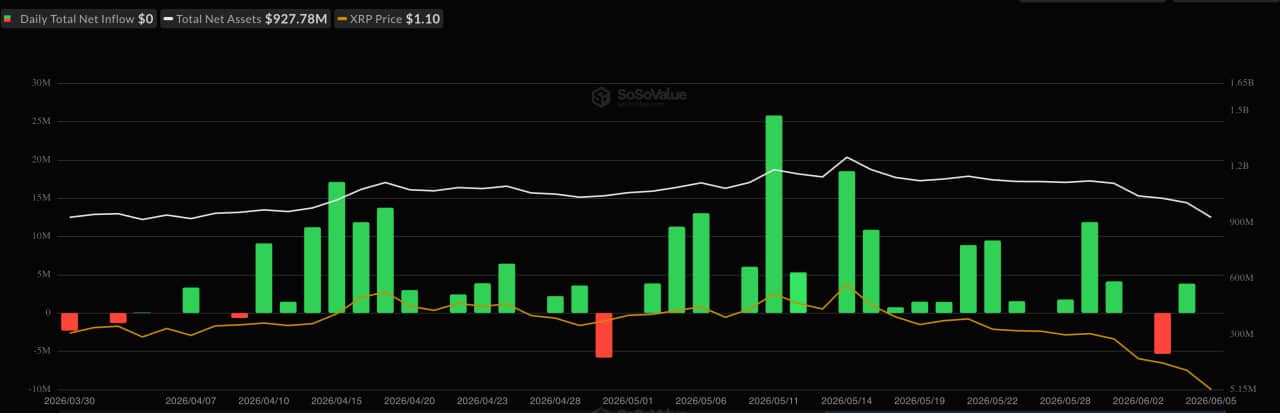
Spot XRP ETFs recorded $131.94 million in net inflows during May 2026, the strongest monthly figure since these products launched, even as the broader cryptocurrency collapse accelerated during the final days of the month.
An additional $4.13 million worth of XRP ETFs came into play in early June. During the same week, the price of XRP set a 19-month low, bringing cumulative inflows of XRP ETFs to $1.43 billion.
The mechanism works as follows: ETF flows represent the activity of authorized participants, typically institutional and large retail allocators, purchasing creation units directly from fund issuers, who in turn receive instant XRP to back those units, reducing the circulating exchange supply.
The difference from similar products is not accidental. During the same period, Bitcoin ETFs lost $4.4 billion over 13 consecutive trading days of outflows, and Ethereum ETFs lost $401 million over 17 days, meaning institutional flow into XRP investment products was going in the opposite direction from every other major category of cryptocurrency ETFs during a massive crypto liquidation event. Bitcoin ETF outflows only broke a 13-day streak on June 4 with an inflow of $3 million, a figure the source material itself describes as insufficient to indicate a reversal.
Source: XRP ETF Flows / SoSoValue
However, it is necessary to point out the epistemological status of these data. ETF flow figures confirm the entry of capital into these products; They do not assert that this capital represents a conviction that will continue through further drawdowns, nor do they set a minimum price on any specific timeline. Approved participants can do reverse positions.
May’s XRP ETF record is notable precisely because it occurred amid a deteriorating price environment, but the same deteriorating environment makes the durability of those inflows an open question rather than a settled one.
The forward-looking status of the XRP ETF flows depends heavily on the CLARITY Act, which would permanently classify XRP as a commodity under US federal law. The bill was approved by the Senate Banking Committee in May and was placed on the Senate legislative calendar on June 1.
Standard Chartered Projections indicate that passage of the CLARITY Act could lead to additional inflows from XRP ETFs worth $4 billion to $8 billion by the end of the year, a number that represents roughly 30 to 60 times May’s record monthly total. This expectation is conditional on setting the Senate meeting date and approving it before the August recess, neither of which can be guaranteed.
explores: The next crypto to explode in Q2
XRP News: What does the difference between XRP price and data actually solve?
If macro conditions stabilize, incoming US inflation data ease concerns about interest rate stabilization, and XRP ETF inflows maintain their trajectory in May-June and July, the 9:1 short-to-long skew becomes an accelerator for a short squeeze rather than a bearish indicator.
The Clarity Act, which is up for a vote in the Senate before the August recess, is adding fuel. Standard Chartered’s forecast of $4 billion to $8 billion in inflows began pricing in before it passed, pushing XRP back toward $1.50 to $1.60 in the near term and toward $2.00 or higher if institutional inflows accelerate. A sure signal is a sustained daily close above $1.30, followed by a volume recovery of $1.40.
If Bitcoin stabilizes between $60K and $65K without decisively recovering to higher levels and the CLARITY Act remains on the Senate calendar without a scheduled vote, XRP consolidates near $1.10 to $1.25. The accumulation of whales continues quietly, but does not find any stimulus in the near term.
Source: XRPUSD / Tradingview
The setup builds without resolution. A sure sign is that news of ETF inflows remains positive on a weekly basis without accelerating, and XRP maintains an unbroken minimum of $1.08.
If Bitcoin tests the $55,000 implied level at Polymarket, it will currently be set at 64% probabilitya renewed round of cryptocurrency liquidations is forcing even high-conviction XRP holders to reduce exposure. XRP’s correlation of 0.87x with Bitcoin’s recent movement suggests a price near $1.05 at $55,000.
A $50,000 test, with a 51% probability, pushes XRP below $1.00. Below that, structural support lies at $0.95, and the $0.75 to $0.85 area represents historical cycle lows. A confirmed signal is a daily close below $1.08 with high volume accompanied by a reversal in ETF flows.
The main indicator in all three scenarios is not the price of XRP itself. This is the weekly ETF flow number. The continuing shift from inflows to outflows suggests that the theory of institutional accumulation is on the wane. Continued flows through further price weakness will deepen divergence and ultimately reinforce the bullish case.
discovers: Best coins to buy in 2026
Disclaimer: Coinspeaker is committed to providing unbiased and transparent reporting. This article aims to provide accurate and timely information but should not be considered financial or investment advice. Since market conditions can change rapidly, we encourage you to verify the information yourself and consult with a professional before making any decisions based on this content.

Daniel Francis is a technical writer and Web3 educator specializing in macroeconomics and DeFi mechanics. A crypto native since 2017, Daniel brings his background in cross-chain analytics to author evidence-based reports and detailed guides. It is certified by the Blockchain Council and is dedicated to providing “information gain” that cuts through the market noise to find blockchain’s real-world utility.



