
Bitcoin fell nearly 3% towards $63,000 after stronger-than-expected US labor market data reinforced the Federal Reserve’s hawkish outlook and lowered expectations for short-term interest rate cuts.
summary
- Bitcoin fell nearly 3% to $63,282, as strong US jobs data reinforced the Federal Reserve’s hawkish outlook.
- Technical indicators turned bearish after BTC broke below the ascending channel and key Fibonacci support.
- Analysts warn that a loss of the $62,400 support area could lead to a retest of the June lows near $59,000.
According to the US Department of Labor DataInitial jobless claims fell to 226,000 for the week ending June 13, down from a revised 230,000 the week before.
The report arrived a day after the Federal Reserve Maintained rates constant at 3.50%-3.75% during the FOMC meeting on June 17, marking a fourth straight pause while policymakers forecast the possibility of additional tightening in 2026. The outlook has prompted traders to reduce exposure to risky assets.
Oil markets provided little support, although crude oil prices fell sharply after reports of progress toward an agreement between the United States and Iran. Framework agreement. While lower energy prices may ease concerns about inflation, traders remain focused on the Federal Reserve’s latest forecasts and the resilience of the US labor market.
Financial derivatives markets also turned defensive. Bitcoin (Bitcoin) fell below $64,000 as leveraged long positions were unloaded across major exchanges, while traders reassessed the potential for near-term interest rate cuts. Meanwhile, continuing jobless claims rose to 1.81 million, a detail that provided some evidence of labor market weakness but failed to offset the market reaction to a decline in headline jobless claims.
Bitcoin is losing ascending channel support as sellers target low liquidity areas
The four-hour chart shows Bitcoin breaking below the lower limit of the ascending channel that has led the price action higher since the June 5 rebound from near $59,000. The breakout occurred below the 61.8% Fibonacci retracement level near $64,950, an area that previously served as support during the recent recovery attempt.
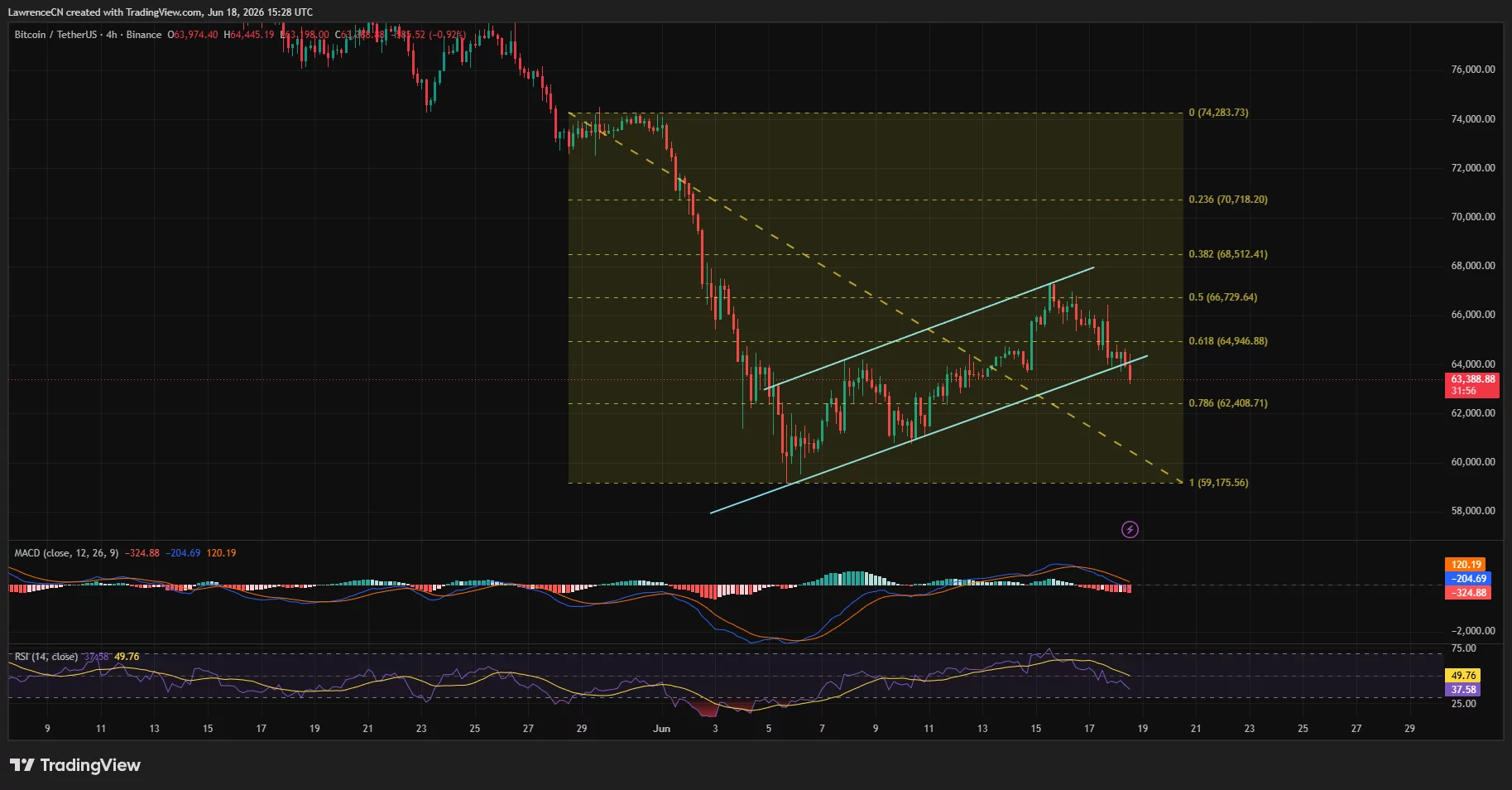
The next major support is near the 78.6% Fibonacci retracement level near $62,400. A daily close below this area could expose the June low near $59,175, which also represents the measured downside target from the channel failure.
Momentum indicators weakened with the collapse. The RSI on the four-hour chart fell towards 38, putting it below neutral territory, while the MACD produced a bearish crossover and turned deeper into negative territory.
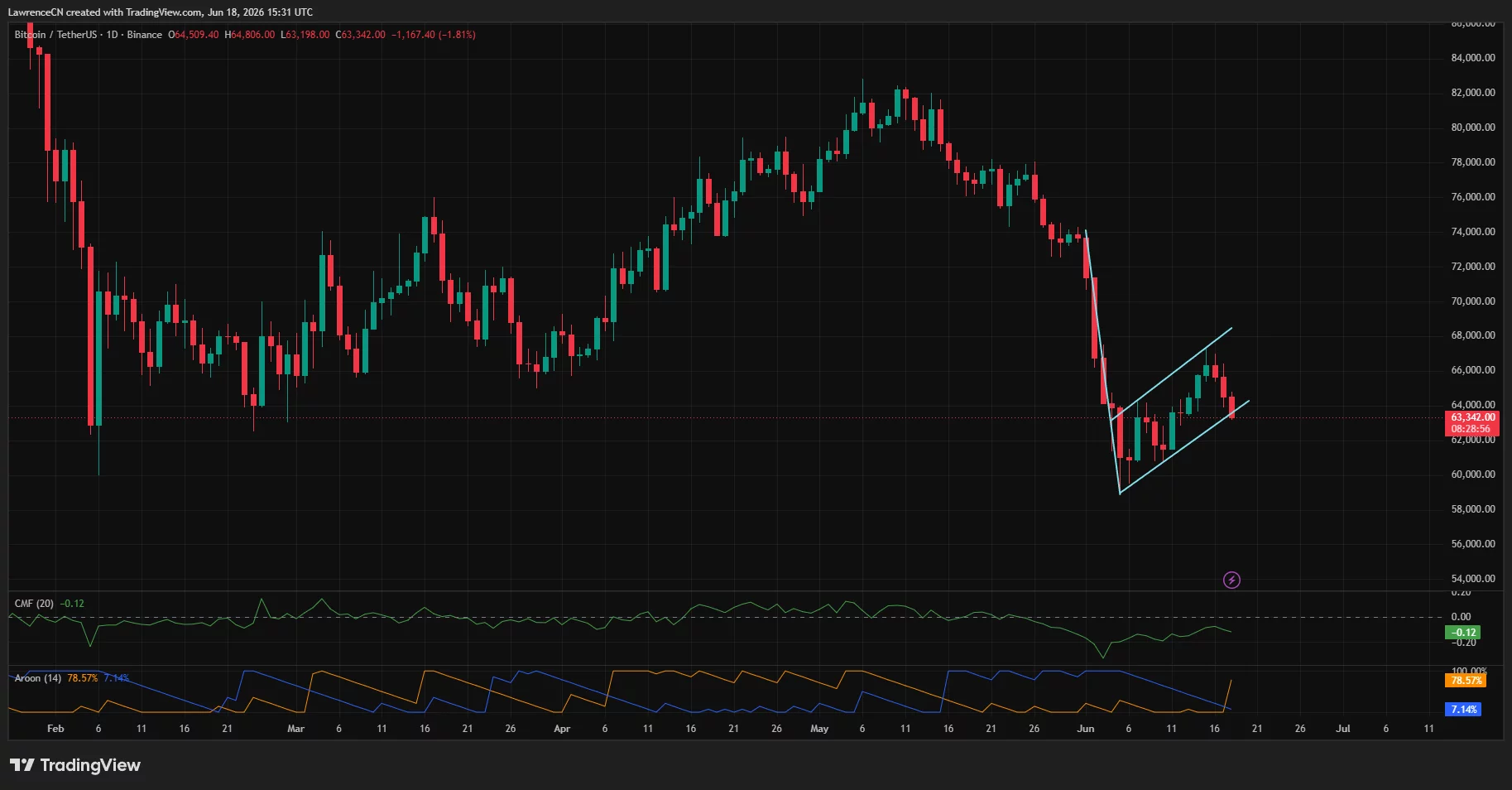
On the daily chart, Bitcoin also formed a bear flag after rebounding from the June low near $59,175 and stopping below the $67,000-$68,000 resistance zone. A flag-confirmed breakout would reinforce the bearish case and refocus on the $60,000-$59,175 support zone.
Chaikin’s fund flow remains below zero at around -0.12, showing capital continuing to leave the market despite last week’s rebound attempt.
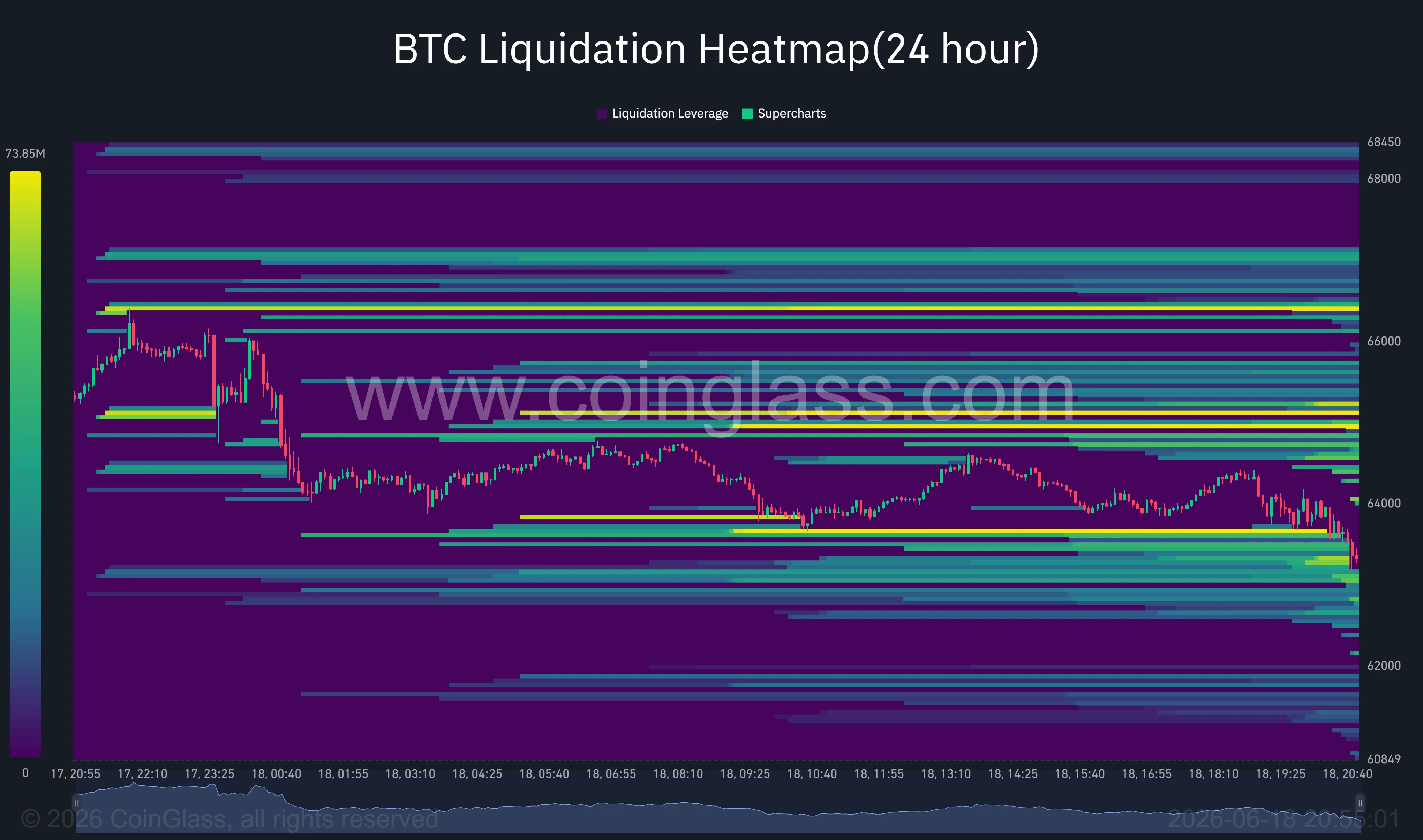
Liquidation data from CoinGlass highlights a dense pool of leveraged positions between $63,000 and $63,500. Additional liquidity sits near $61,000 and $62,000, while large short liquidation areas remain around $65,000 and $66,500. With Bitcoin trading directly into a long leverage concentration, volatility could remain high over the next several sessions.
Commenting on the recent collapse, cryptocurrency analyst Altcoin Sherpa warned that Bitcoin could return to the $60,000 area in the coming days if the current support area gives way.
A break below $62K could open the door to a retest of the June lows
Analysts are increasingly focusing on whether Bitcoin is able to defend the current support area. According to For cryptocurrency analyst Michael van de Poppe, the market is approaching a pivot level that could determine the next directional move.
“This is the level that needs to be maintained for Bitcoin. It is pivotal. If it doesn’t happen, we will test the lows and the markets are about to fall further on altcoins.”
A sustained move below $62,400 would strengthen the bearish case and increase the likelihood of a retest of the June low near $59,000. Technical factors aside, another bullish surprise in inflation data or additional hawkish comments from Fed officials could dampen expectations of policy easing and increase pressure across cryptocurrency markets.
For bulls, reclaiming the support of the broken channel and reclaiming the $64,950-$66,700 area will be the first sign that sellers are losing control. Until then, traders remain focused on bearish liquidity areas as Bitcoin struggles to stabilize following the Fed meeting and stronger-than-expected labor market data.
Disclosure: This article does not constitute investment advice. The content and materials contained on this page are for educational purposes only.



