

Clarity ACT News: Jefferies analysts led by Andrew Moss published a report on June 30, 2026, warning that the CLARITY Act, a proposed US cryptocurrency market structure bill that would draw jurisdictional lines between the SEC and CFTC over digital assets, faces an increasingly compressed and uncertain path to passage in the Senate, with Polymarket The odds of the law passing at the end of 2026 are 48%, down from 70% in mid-May, with roughly 20 legislative days remaining before the August recess.
JUST IN: Investment bank Jefferies warns that cryptocurrency markets could face volatility as Senate path to Clarity Act narrows, with… @polymarket The odds of success by the end of the year drop from 70% to 48%. pic.twitter.com/WrI6iNauhV
— CoinDesk (@CoinDesk) June 30, 2026
This is not just a scheduling problem. It’s a structural inflection point for institutional adoption of cryptocurrency infrastructure: the difference between a permanent legal framework and a set of agency directives that any future administration could reverse.
Clarity Act News: How the Senate schedule became the central danger
The bill was approved in the House on July 17, 2025, by a vote of 294-134, and passed the Senate Banking Committee on May 14, 2026, in a bipartisan vote of 15-9, before being placed on the Senate calendar on June 1, 2026.
Passage by the full Senate requires 60 votes, meaning at least seven Democrats, a threshold complicated by unresolved disputes over ethics provisions, illicit financing language, and, most pressingly, whether stablecoin issuers will be able to pay the yield on dollar-pegged tokens. These sticking points have already stalled floor scheduling onceThe legislative calendar provides only a small margin for a second delay.
Moss and his team stated that failure to advance before August could push the bill into 2027 or beyond if Democrats regain control of the Senate in November’s midterm elections. JPMorgan issued a parallel warning earlier in June, describing the congressional calendar as tight and the stablecoin yield debate unresolved. Galaxy Research has trimmed its probability estimates to approximately 50-55%.
Traffic versus delay: what does the regulatory framework open up or lose?
According to Jefferies, passage would give banks, asset managers and exchanges the express legal authority they need to expand tokenization services, custodial arrangements, mortgages and lending products, a license that approximates existing SEC, CFTC and OCC guidance but does not replicate.
The bill’s decentralization test, which determines when a network token transitions from a security subject to the jurisdiction of the Securities and Exchange Commission (SEC) to a commodity subject to oversight by the Commodity Futures Trading Commission (CFTC), is the legal structure that ETF lawyers argued is necessary to expand spot crypto ETF approvals beyond bitcoin and ether to large-cap value tokens including SOL and AVAX. BlackRock’s recent expansion into Bitcoin-linked ETF structures It shows how quickly product development moves once the regulatory path is established.
JUST IN: 🇺🇸 SEC Commissioner Hester Peirce on the Clarity Act: “I remain optimistic it will get done this summer.”
“I expect we’ll see that pass soon.” 🚀 pic.twitter.com/DwiZcJwy2a
– Bitcoin Magazine (@BitcoinMagazine) July 1, 2026
Jefferies also identified the bill as a prerequisite for reviving the cryptocurrency IPO pipeline. The CLARITY Act would create a dedicated disclosure regime for additional asset creators, lighter than full securities registration, allowing compliant token fundraising and secondary trading on CFTC-registered digital commodity exchanges once decentralization thresholds are met. Without it, potential issuers remain vulnerable to case-by-case SEC scrutiny.
In a delay scenario, regulated financial institutions will remain dependent on reversible agency actions. Jeffries described this dynamic as an impediment to blockchain initiatives as compliance teams reassess legal risks under an enforcement-driven system rather than a law-based one, which is precisely the pattern that has governed the structure of the US cryptocurrency market since around 2020, according to JPMorgan’s framework.
Stocks in focus: Circle, Coinbase and Bullish Volatility Index are marked
Jefferies expects the legislative process itself to increase volatility in cryptocurrency-related stocks, naming Circle (CRCL), Coinbase (COIN), and Bullish (BLSH), the parent company of CoinDesk, as key names included in the focus.
For Circle specifically, the bank described mixed implications: The current bill would close a loophole that allows third parties like Coinbase to offer rewards on USDC holdings, which could restrict USDC growth in the near term, while the delay gives Circle additional runway to diversify revenue and expand its payments network.
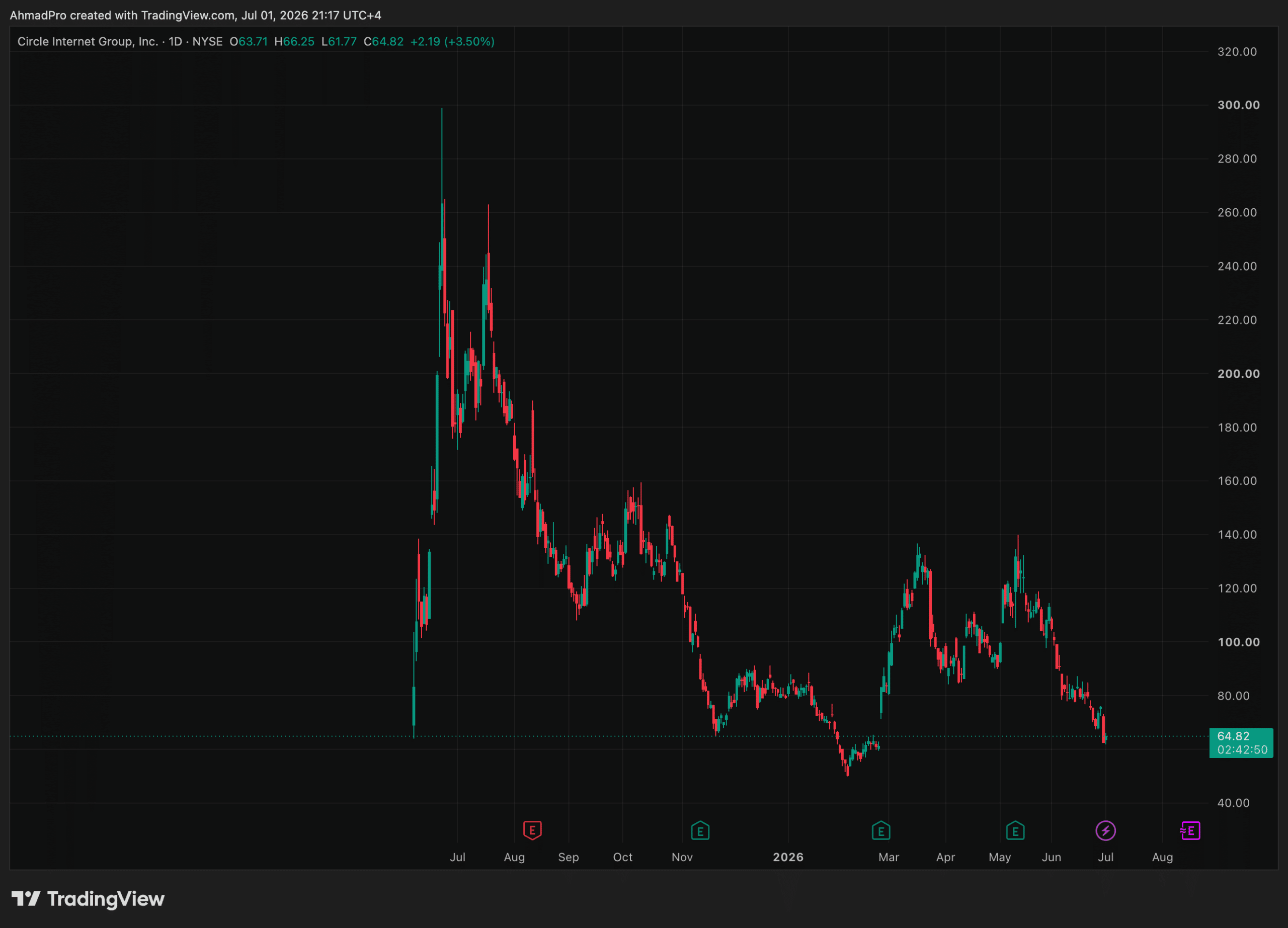
Source: CRCLUSD / Tradingview
Longer term, Jefferies described intense competition from bank-issued stablecoins as the most significant structural risk for Circle, a risk that regulation neither creates nor solves.
We believe the market has not fully priced in the inconsistency between these two scenarios, given that market forecast probabilities now lie in a region close to currency volatility, while stocks in the sector have not been re-priced proportionately to reflect the base case of a prolonged regulatory vacuum. July text release and Senate vote schedule The next concrete signal will be to see if this gap will close on the upside or downside.
Disclaimer: Coinspeaker is committed to providing unbiased and transparent reporting. This article aims to provide accurate and timely information but should not be considered financial or investment advice. Since market conditions can change rapidly, we encourage you to verify the information yourself and consult with a professional before making any decisions based on this content.

Neil is a professional cryptocurrency content writer with years of experience. He has written for numerous cryptocurrency websites to report breaking news, and has been hired by all kinds of cryptocurrency projects, to create content that will increase their exposure and attract more potential investors.



