
Elon Musk’s SpaceX has received fresh buy ratings from several major Wall Street banks, with Morgan Stanley assigning a base case price target of $300 as the stock prepares to join the Nasdaq-100.
summary
- Morgan Stanley leads new buy calls on Wall Street with a $300 base condition and a $600 upside target for SpaceX.
- JPMorgan estimates that the inclusion of the Nasdaq 100 could lead to about $4.3 billion in passive fund buying.
- SpaceX shares fell ahead of the index’s debut despite bullish analyst ratings and strong institutional interest.
According to research notes from Morgan Stanley, Goldman Sachs, Citigroup and other investment banks, analysts expect more gains for SpaceX even though the stock is pulling back after its recent rally.
The latest recommendations come just before the company enters the Nasdaq 100, an event that JPMorgan estimates could trigger $4.3 billion in automatic purchases by passive investment funds.
Morgan Stanley sees Starship and Starlink as driving long-term value
Morgan Stanley initiated coverage of SpaceX with an Overweight rating. Analyst Adam Jonas set a base case price target of $300 and a bullish case target of $600, suggesting a significant upside from the stock’s most recent trading price.
According to Jonas, SpaceX’s investment case is supported by the economics of the Starship launch program, the expansion of Starlink’s satellite network, and the company’s role in building space AI infrastructure.
Goldman Sachs also initiated coverage with a buy rating and a price target of $205. SpaceX is well positioned across the space, connectivity, and AI industries, analyst Eric Sheridan wrote, adding that each of these markets has the potential to become “multi-trillion-dollar opportunities over a 5-year+ time horizon.”
The bullish coverage extended beyond those companies. Citigroup assigned a buy rating with a 12-month price target of $200, while UBS and Wells Fargo also initiated coverage with positive recommendations, adding to growing institutional support for the newly listed company.
The entry into the Nasdaq 100 could push billions into buying passive funds
Attention has also turned to SpaceX’s scheduled listing on the Nasdaq-100 on July 7.
According to the Nasdaq announcement, the company qualified under updated index rules that allow certain large, newly listed companies to enter the index just 15 trading days after their public debut.
JP Morgan Estimates Exchange-traded funds and index funds that track the Nasdaq-100 will need to buy about $4.3 billion worth of SpaceX shares once the rebalancing process takes effect.
The purchase is expected to take place around the time the market closes on July 6 and opens on July 7, as passive funds such as the Invesco QQQ Trust will have to match the revised index regardless of their view on the company’s valuation, the bank said. SpaceX is expected to enter the benchmark with an index weight of less than 1%.
Despite a wave of bullish analyst ratings, SpaceX shares have come under selling pressure. The stock closed Monday down 0.98% at $160.42, trimming its weekly gains to just over 2% after profit taking. However, by early Tuesday afternoon, the stock was down 5.31% to $151.90 after the market opened, extending losses even as investors digested its inclusion in the Nasdaq 100.
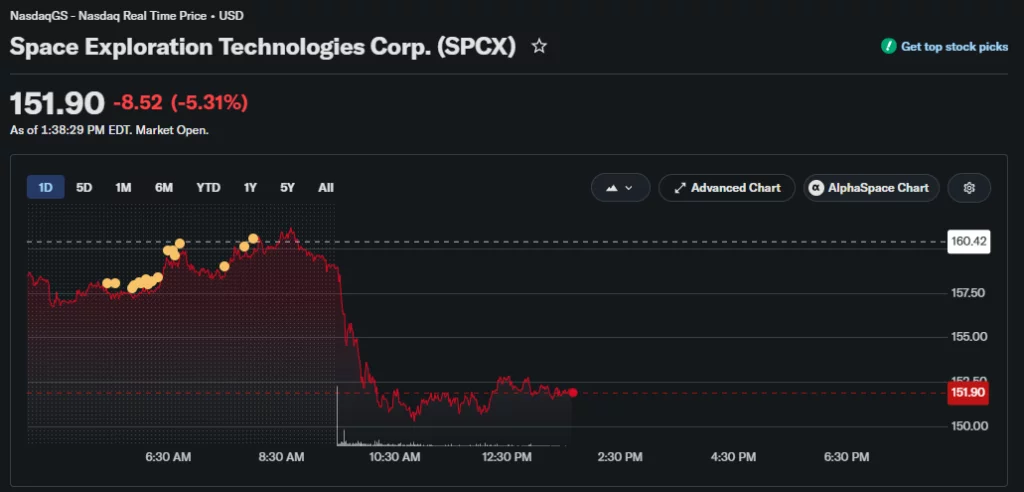
Derivatives trading also indicated cautious sentiment. SPCX USDC perpetual contracts on Hyperliquid were trading down approximately 3.15% at $159.17, with trading volume reaching nearly $284 million at press time.
Meanwhile, the cryptocurrency market has remained steady alongside developments surrounding SpaceX.
Bitcoin settled above its 200-week moving average at $62,865 and traded near $63,300 after hitting a 24-hour high of $64,597. Volume remained over 70% higher with greyscale Argue The strategy’s recent Bitcoin sales could help identify the bottom of the market.



