
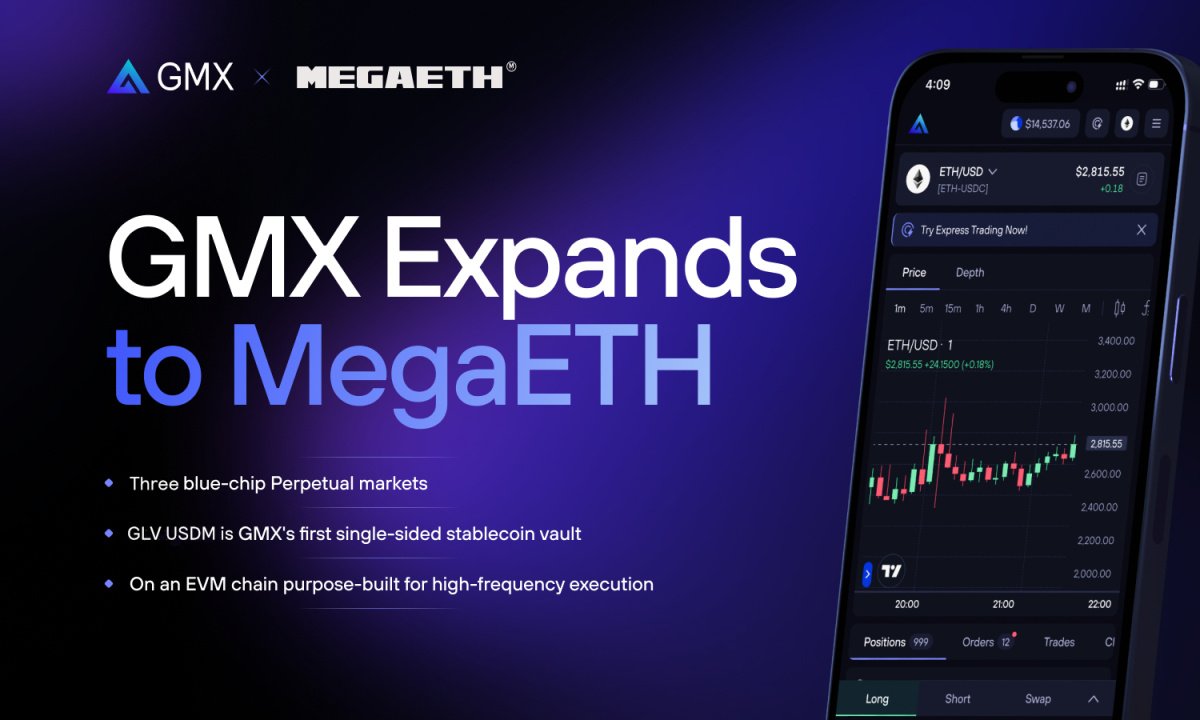

Nassau, Bahamas, March 30, 2026, Chainwire
GMX, the battle-tested trading infrastructure that has served over 740,000 traders across 8 chains, has launched on MegaETH – bringing its proven liquidity structure to the first real-time blockchain.
A long-standing question among cross-chain traders has been whether decentralized perpetual trading platforms can achieve execution speeds similar to centralized exchanges. GMX and MegaETH make a case that such parity may be possible.
GMX – the non-custodial trading platform that has facilitated over $363 billion in virtual volume – is Now live on MegaETHthe first blockchain with 10ms block times and serialization level Chainlink data streams Merger. This pairing is deliberately paradoxical: the most proven infrastructure in decentralized derivatives, deployed on the newer, more technically ambitious EVM chain.
GMX has a proven track record of identifying high-potential ecosystems early and growing alongside them. Just as the Perp DEX has proven itself as a foundational layer for liquidity and returns on Arbitrum since its early days – helping to define what DeFi could look like – the protocol brings the same early conviction to MegaETH.
Instead of waiting for the ecosystem around it to mature, GMX is positioning itself as a trading venue and returning infrastructure for MegaETH creators and users from the beginning. MegaETH is the eighth chain on which users can trade on GMX, and the first specifically designed for real-time on-chain execution.
When speed becomes infrastructure
MegaETH’s 10ms block generation highlights potential improvements in on-chain perpetual architecture. For GMX, which uses Chainlink oracle feeds to enable markets with transparent prices, producing blocks faster enables traders to receive price updates at a frequency traditionally associated with centralized exchanges.
The initial deployment takes place on GMX’s battle-tested peer-to-pool liquidity infrastructure and Chainlink’s industry-standard data feed network; The same stack that guarantees billions in weekly volume across seven other chains. This is a deliberate choice: before pushing the boundaries of what MegaETH makes possible, GMX ensures that the foundation users rely on is very strong.
The second deployment phase is already on the roadmap. Once the initial launch demonstrates performance at scale, GMX will gradually introduce MegaETH-specific improvements. Consider: CEX-like order execution that takes advantage of the speed of the chain block, and improved price update mechanisms through the chain level Chainlink data streamsAnd advanced trading features enabled by MegaETH’s computational throughput. The architecture is designed to evolve, without disrupting the traders who rely on it today.
DeFi’s return and liquidity layer, now on MegaETH
The launch of MegaETH represents a continuation of GMX’s horizontal expansion strategy, which has contributed to its widespread availability and integration with DeFi. For the MegaETH ecosystem, establishing GMX as the primary platform for trading and revenue generation provides an established liquidity layer that other protocols can integrate with. Several partners have indicated plans to leverage the composable GMX framework to build additional functionality.
Currently, GMX is integrated with over 70 DeFi protocols, trusted by over 45,000 liquidity providers, and Accessible on every EVM compatible major seriesIn addition On Solana. This depth of integration reflects GMX’s role as an underlying DeFi infrastructure for public blockchains, not just a trading app. MegaETH protocols looking for a strong liquidity backbone now have one. The “Trade Anywhere, GMX Everywhere” thesis is no longer an item on the roadmap; It is a practical reality. And MegaETH is its latest frontier.
The famous GMX Referral system It went live, meaning anyone in the MegaETH community can immediately start earning commission by signing up and sharing a referral link.
USDm Stablecoin Vault
For users who want to put capital to work rather than take directional risk, GMX’s MegaETH launch brings something completely new to the protocol: the first stablecoin-only liquidity vault.
GLV Vault: (USDM/USDM) allows users to deposit USDm – MegaETH’s native stablecoin – and earn an automatically compounded return from three different revenue streams simultaneously: trading fees, swap fees, and buy/sell fees on the liquidity tokens themselves. GLV Vault dynamically reallocates its liquidity across markets in response to real-time trader demand, automatically optimizing return with no manual management required.
This is the first time GMX has offered a vault without exposure to cryptocurrency volatility, creating a return opportunity tailored specifically for capital-conservative participants. A USDm vault, like trading on GMX, may also qualify users for chain-specific incentives. MegaETH tracks wallet activity on-chain; Early participants may be well positioned for the upcoming incentive campaign.
Traders can open standing positions in BTC/USD, ETH/USD, and SOL/USD with up to 50x leverage and a maximum price leverage of 0.5%. Liquidity providers can start earning from USDm treasury.
Users can start trading or provide liquidity on: app.gmx.io
Or seamlessly connect to MegaETH first via the main ecosystem gateway, Rabbit hole.
About GMX
GMX is the leading permissionless perpetual exchange platform. GMX operates across 8 public blockchains, offers significant liquidity, 100+ transparent markets, up to 100x leverage, and Chainlink oracle pricing in less than a second. Composable GM pools and GLV vaults allow tens of thousands of LPs to earn protocol fees, positioning GMX as the underlying liquidity and execution layer for multiple DeFi chains.
Website: gmx.io | program: app.gmx.io | Twitter/X: @GMX_IO | Blog: GMX News Blog
About Megaeth
MegaETH is the first real-time blockchain network, secured by Ethereum and supported by a highly optimized execution environment with a heterogeneous architecture. It offers streaming throughput with 10ms block times and up to 100,000 TPS. Developers scale applications with real-time status streaming, and users get instant transactions, all while maintaining the full configurability of Ethereum.
communication
Disclaimer: This is a sponsored press release and is for informational purposes only. They do not reflect the opinions of Crypto Daily, and are not intended to be used as legal, tax, investment, or financial advice.



