
Delaware has introduced Senate Bill 19 (SB 19), legislation that would place stablecoin issuers under the state’s existing banking supervisory framework and position the state as an authorized regulatory authority under the federal Guiding and Establishing National Stablecoin Innovation in America Act (GENIUS Act), passed in July 2025.
Spyros Mantzavinos and Representative Bill Bush, after direct consultation with Delaware’s financial industry, the bill creates a formal licensing path for payment stablecoin issuers operating below the $10 billion consolidated issuance threshold set by federal law. The implications extend beyond Dover, as Delaware’s move sets the terms for how state-level regulation can coexist with, and perhaps replace, federal oversight of cryptocurrency issuance.
The timing is not accidental. The GENIUS Act requires all state regulators seeking certification to issue implementing rules by July 18, 2026, leaving Delaware approximately four months from submission to finalize a framework capable of surviving federal scrutiny. SB 19 is positioned as precisely that compliance vehicle.
🚨New: Delaware bill mandating 1:1 reserves for stablecoin issuers
The state of Delaware has unveiled new legislation to regulate stablecoins. The draft law places issuers under a government banking structure.
The proposed law requires full backup support. Every stablecoin issued must be matched… pic.twitter.com/IaZ2AkG5ZF
-BSCN (@BSCNews) March 24, 2026
explores: Hyperliquid opens American Policy Defense Center
SB 19 Mechanics: Licensing, Reserves, and Federal Certification Threshold
Under SB 19, stablecoin issuers seeking to operate within Delaware’s jurisdiction would be required to obtain a license from the state’s Office of the State Bank Commissioner, the same body that oversees state-chartered banks and credit companies.
The bill adopts the GENIUS Act definitional standards for payment stablecoins, pegged digital instruments designed for use as a means of payment, and imposes reserve requirements consistent with the federal framework, requiring issuers to hold high-quality liquid assets on an individual basis in exchange for tokens.
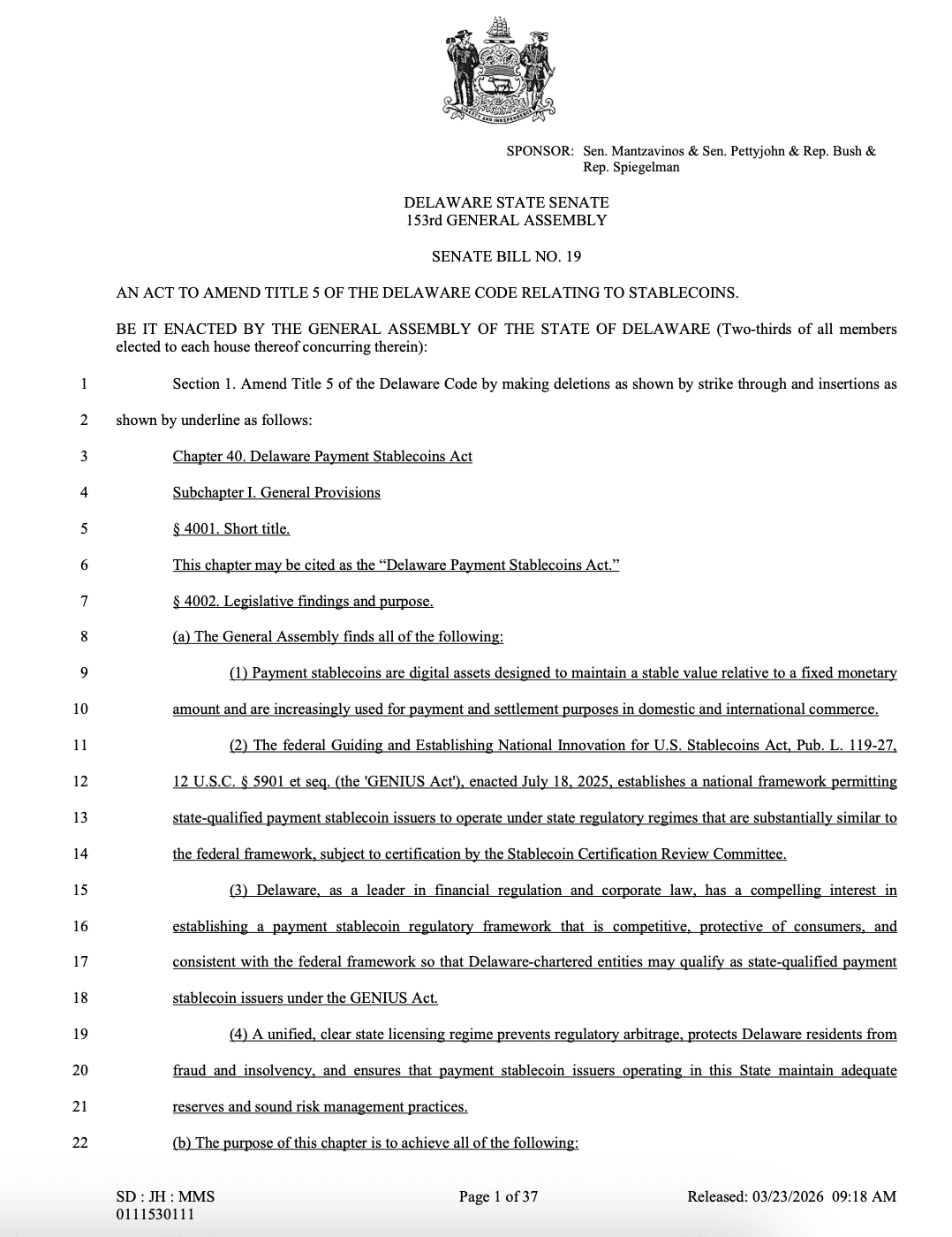
(source: Delaware Law)
A critical structural feature of the legislation is the $10 billion dual-track threshold included in the GENIUS Act. Issuers with a pending consolidated issuance below this number may operate under a qualified state system rather than direct federal oversight, provided that the Stablecoin Certification Review Committee (SCRC), made up of representatives from the Treasury Department, the Federal Reserve, and the Federal Deposit Insurance Corporation (FDIC), certifies the state framework as “substantially similar” to the federal standards within 30 days of submission.
Delaware’s adoption of the GENIUS Act definitions wholesale appears calculated to facilitate certification review. Issuers that then violate the $10 billion cap must move to federal supervision within 360 days or halt new issuances, although the law provides waiver mechanisms for states with established supervisory records.
Issuer Implications: What it takes to actually comply with a Delaware stablecoin
For issuers like Circle, Paxos, and their smaller competitors, SB 19’s practical requirements mirror and, in some ways, replicate existing New York Department of Financial Services (NYDFS) BitLicense obligations, which have required monthly reserve certifications, independent audits, and prior approval of material business changes since 2015.
Delaware’s framework, if adopted, would represent less a lighter regulatory touch than a geographically and administratively distinct path to similar status. Issuers already subject to NYDFS oversight will face the added complexity of dual state compliance if they seek Delaware certification for a separate issuing vehicle, a point of friction that analysts expect to generate early lobbying activity around alignment.
Delaware has officially introduced the Delaware Payment Stablecoins Act (SB 19).
The bipartisan bill, sponsored by Senators Mantzavinos and Pettyjohn, aims to create an elite, nationwide licensing system for securities issuers.
Delaware is positioning itself to be the “gold standard”… pic.twitter.com/TplwFdwQ7T
– Conor Kenny (@conorfkenny) March 24, 2026
The reserve requirements imposed by the Genius Act, which limit eligible collateral to U.S. Treasury securities, central bank reserves, and similarly high-quality short-term instruments, limit the differentiation that Delaware can offer on the asset side.
Perhaps what distinguishes the state is the pace of examinations, licensing fees, and the responsiveness of a smaller administrative body to industry inquiries. Whether that managerial agility outweighs the brand recognition of NYDFS oversight of institutional counterparties remains an open question that issuers will answer through their incorporation filings.
Federal alignment and regulatory picture between states
Delaware’s move arrives while the broader stablecoin regulatory structure in the US is still being assembled. The GENIUS Act sets the federal precedence framework, but the SCRC’s “substantial similarity” criteria, the criteria that Delaware’s system must meet, are subject to federal regulatory guidance expected by January 18, 2026.
This guidance will determine whether states have real flexibility in supervisory mechanisms or are effectively required to mirror federal rules line by line. Other states with active digital asset legislative agendas, including Texas and Wyoming, are closely monitoring Delaware’s certification bid; A successful outcome would validate the dual-track model and potentially accelerate parallel application processes at the country level.
The risk of federal preemption, which has historically been a live concern in the money transfer context, is mitigated but not eliminated by the explicit adaptation of state regulations in the GENIUS Act. If Congress reconsiders the structure of the law, or if the SCRC imposes certification requirements that Delaware cannot meet without a statutory amendment, state issuers will face an abrupt transition timeline to return to federal supervision.
🇺🇸”We are no longer securities and everything is a commission”
The SEC has issued an interpretation clarifying the application of federal securities laws to digital assets using the definitions in the GENIUS Act.
The document describes Bitcoin and other digital assets as… pic.twitter.com/dRIpEDkuvq
– Anger (@theragetech) March 18, 2026
The next concrete decision point is SCRC certification review, which must conclude within 30 days of Delaware’s formal filing, a clock that will not begin until SB 19 is enacted and the Commissioner’s implementing rules are finalized. Issuers and their attorneys should monitor the federal guidance window that closes on January 18, 2026, which will determine the “substantial similarity” floor that the Delaware framework must clarify.
If the legalization process continues on schedule, Delaware could emerge as the first state outside of New York to offer a federally recognized stablecoin supervisory path, a development that would redraw the competitive map for cryptocurrency issuance before the July 2026 GENIUS Act implementation deadline.
Disclaimer: Coinspeaker is committed to providing unbiased and transparent reporting. This article aims to provide accurate and timely information but should not be considered financial or investment advice. Since market conditions can change rapidly, we encourage you to verify the information yourself and consult with a professional before making any decisions based on this content.

Daniel Francis is a technical writer and Web3 educator specializing in macroeconomics and DeFi mechanics. A crypto native since 2017, Daniel brings his background in cross-chain analytics to author evidence-based reports and detailed guides. It is certified by the Blockchain Council and is dedicated to providing “information gain” that cuts through the market noise to find blockchain’s real-world utility.