

Qubic will begin its phased transition from Monero to Dogecoin mining on April 1. With
In a mail Published on Tuesday, the project said that “the transition from Monero to Dogecoin does not happen overnight” and that its core team has designed a three-stage process where “each stage is evaluated before moving forward.” This framework is notable given Qubic’s increasingly clear language around its mining strategy. The main goal, as the team describes it, is to reach an end state where DOGE + AI operates “simultaneously, full-time.”
Three-stage rollout of Dogecoin mining
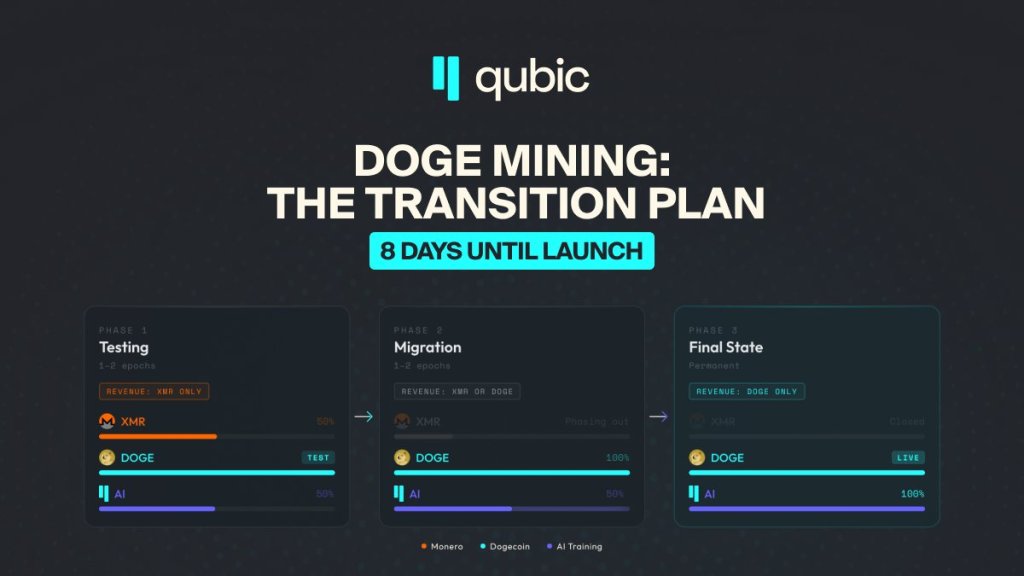
First stage Starts April 1 It is established as a trial period lasting from one to two eras. During that phase, computer revenue remains denominated in XMR only, Monero mining remains active 50% of the time, and Dogecoin enters what Qubic calls “test mode” while running on the mainnet 100% of the time. Artificial intelligence training continues alongside him. In other words, Qubic does not immediately remove the current Monero-based incentive structure, but offers DOGE at full operational density before revenue transfer.
The second stage is the actual migration. For a period of one or two epochs, computers will be able to choose between XMR and DOGE revenues, with XMR starting to phase out and DOGE gradually coming into play as top-ups apply. Qubic also said that computers that choose to fetch DOGE “are no longer eligible to receive XMR.”
By the third and final phase, Qubic says PC revenue will only be DOGE. The XMR sender will be completely turned off, DOGE will remain active 100% of the time, and the AI training will also be running 100%. “No rush. No shortcuts. Just disciplined execution,” the team wrote.
Qubic has paired this roadmap with a performance claim aimed directly at the April 1 launch window. On March 23, the project said its network had done so Get “3x faster” on the live mainnetwith hash times reduced from 2 seconds a year ago to 1 second and now 0.6 seconds after the last fundamental improvement.
“Every share submitted by a miner is verified by Oracle Machines with one click,” Qubic wrote. “Faster hashes mean faster confirmations, a more efficient pipeline, and a network that can handle the load come April 1st. The network got faster before it was needed.”
The economic case for targeting Dogecoin is clear and straightforward in Qubic’s narrative. In a post dated March 20, the team pointed to the previous Monero campaign, saying it had fallen from less than 2% of Monero hash rate reaches 51%+ dominance In a live takeover event,” generating over $3.5 million in mining revenue and creating over 26,000 XMR blocks.
Dogecoin is a much bigger prize, she said. “DOGE produces approximately 14.4 million coins per day. At current prices, this amounts to approximately $1.44 million in daily emissions, nearly 10 times what Monero was producing,” the team wrote. “Same rules of the game. Much bigger goal.”
At press time, DOGE was trading at $0.09752.
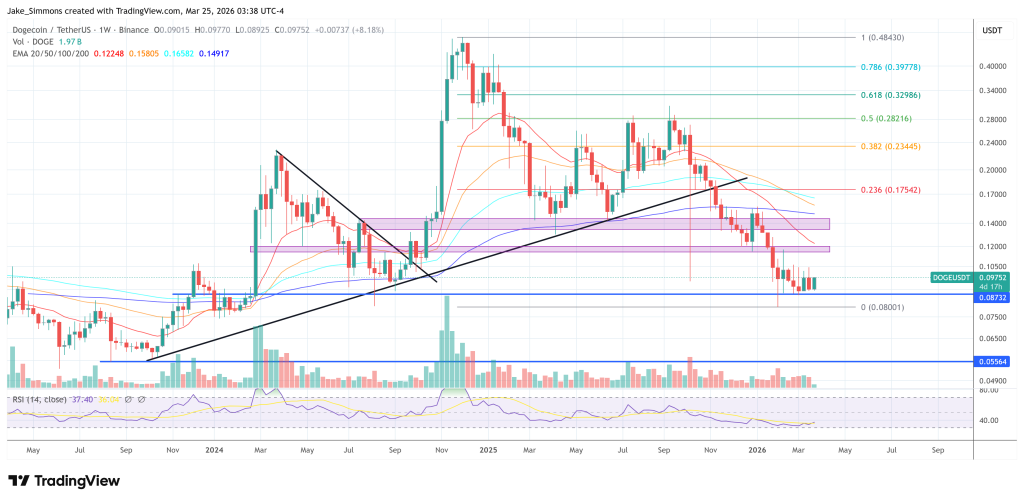
Featured image created with DALL.E, a chart from TradingView.com
Editing process Bitcoinist focuses on providing well-researched, accurate, and unbiased content. We adhere to strict sourcing standards, and every page is carefully reviewed by our team of senior technology experts and experienced editors. This process ensures the integrity, relevance, and value of our content to our readers.