
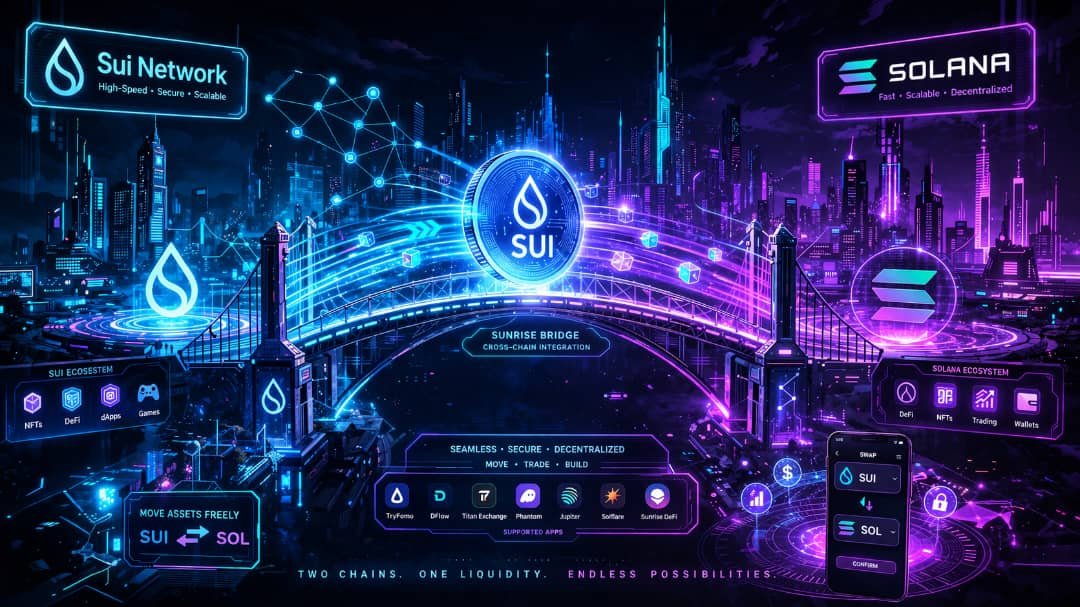
The Sui network’s native token, $SUI, creates a file It moves outside its home range. With the new integration powered by Sunrise DeFi, the token is now live on the Solana blockchain, a move that brings two fast-growing ecosystems closer together.
It’s a simple ad on the surface, but it points to something bigger. Instead of working in separate paths, Sui and Solana are now connected in a way that allows users to transfer value between them more freely.
For everyday users, this means more flexibility. For the broader market, this is another sign that cryptocurrencies are slowly leaning towards a more connected, cross-chain future.
Connecting two high-speed Layer 1 networks
The integration is done through the Sunrise DeFi Bridge, which acts as a link between Sui and Solana. Bridges are nothing new in the cryptocurrency space, but what stands out here is the type of networks connected.
Both Sui and Solana are known for speed and performance. They have built their identities around handling large amounts of activity without slowing down. Bringing them together isn’t just about convenience, it’s also about bringing together two ecosystems that are moving quickly on their own.
With this setup, users can move $SUI across chains without jumping through a lot of hoops. It’s a much smoother process compared to what cross-chain transfers used to look like, and that’s an important thing to embrace.
Open direct trade across ecosystems
One of the biggest changes is how $SUI is traded now. Instead of relying on centralized exchanges or complex methods, users can trade directly against Solana-based assets.
This may seem like a small shift, but it makes a real difference. Fewer steps means less friction, and less friction usually leads to more activity. Traders can react faster, and liquidity can move more naturally between markets.
It also gives $SUI access to Solana’s already active DeFi scene. This is where a lot of trading happens, and being part of that environment can help the token gain more visibility and usage over time.
Expand your reach with popular Solana applications
Another important part of this proposition is where $SUI appears. And it’s not just sitting on the net, it’s already built into many applications that people already use.
Platforms like TryFomo, DFlow, Titan Exchange, Phantom, Jupiter Exchange, Solflare, and Sunrise DeFi now support the token. This means that users don’t need to go out of their way to interact with it.
If you are already using Solana wallets like Phantom or Solflare, or trading through Jupiter, you can access $SUI without changing your usual setup. This kind of familiarity makes a difference. People are more likely to try something new when it fits with tools they already trust.
A step towards smooth movement across the chain
In addition to trading, the bridge also facilitates the transfer of $SUI between Sui and Solana. This flexibility is important, especially in a space where assets are often stuck on a single chain.
It’s not perfect yet, and movement through the series still has its challenges, but it’s getting better. Each new integration like this removes barriers that used to make switching networks seem complicated.
For users, this means more control over where their assets are located and how they are used. For developers, it opens the door to building applications that aren’t tied to just one ecosystem.
What this means for the broader cryptocurrency landscape
Zooming out, this movement is proportional to a larger trend. Cryptocurrencies are gradually shifting from isolated ecosystems to more connected ones. Instead of competing in silos, networks began to connect and share liquidity.
For Sui, launching $SUI on Solana is a way to reach new users and expand its presence. For Solana, it brings new liquidity and another community to engage with.
It also says something about the direction things might be headed. The future may not be about one franchise winning it all, but rather about how well different franchises work together.
This integration will not change everything overnight. But it’s another step in that direction. If more projects follow this path, moving assets across networks may eventually seem as natural as sending cryptocurrencies from one wallet to another.
Disclosure: This is not trading or investment advice. Always do your research before purchasing any cryptocurrency or investing in any services.
Follow us on Twitter @themerklehash To stay up to date on the latest Crypto, NFT, AI, Cybersecurity, and Metaverse news!



