

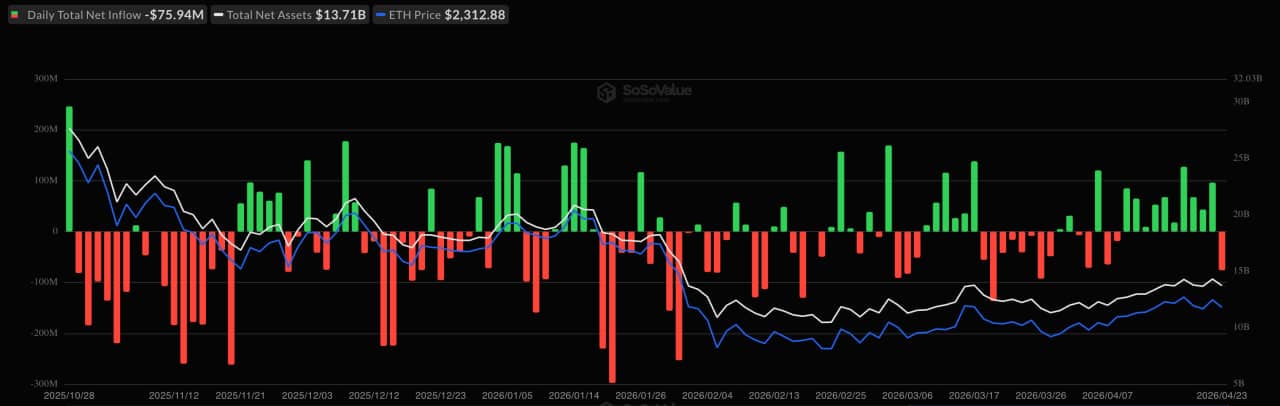
US Ethereum ETF products recorded their 10th straight day of net inflows on April 22, 2026, now marking the longest uninterrupted string of inflows since the funds launched in July 2024, with BlackRock’s iShares Ethereum Trust (ETHA) leading the session at $53.6 million and Fidelity’s Wise Origin Ethereum Fund (FETH) contributing an additional $40.6 million, according to data tracking it. SoSoValue.
Sustained supply from institutional investors acts as a mechanical floor for the price, absorbing the sell-side pressures that have periodically suppressed the ETH price throughout Q1 2025.
explores: Best coins to buy in 2026
Ethereum spot ETF flow data: What ten consecutive days of net buying actually represents
The mechanism works as follows: Every dollar of net inflow into Ethereum spot ETFs obligates the issuing fund to actually acquire ETH on open markets, reducing the liquid float available to sellers and tightening the supply-demand balance at prevailing price levels.
On April 21 alone, the ninth day of the series, total net flows reached $43.36 million, according to SoSoValue. BlackRock’s subsidiary ETHA contributed $37 million, and its subsidiary ETHB added $15.46 million; Grayscale’s Ether Mini Trust received $3.93 million, and Bitwise’s ETHW received $1.99 million.
Offsetting these inflows, Grayscale’s legacy Ethereum Trust (ETHE) saw $12.14 million in exits, and Fidelity’s FETH recorded $1.99 million in outflows, a pattern that mirrors the rotation dynamic observed in Bitcoin ETFs, as investors shifted capital from legacy, high-fee products to lower-cost alternatives from BlackRock and Fidelity.
source: SoSoValue
The tenth day expanded this pattern. The $53.6 million from ETHA and $40.6 million from FETH were partially offset by an outflow of $9.2 million from ETHE, consistent with a structural migration away from Grayscale’s original trust product.
Total net assets across the spot Ethereum ETF pool were approximately US$13.66 billion as of April 21, with a total trading volume of US$648.88 million – numbers that reflect a product suite that is still building liquidity depth but is clearly past the post-launch outflow phase. For context, Bitcoin ETFs recorded just $11.84 million in net inflows on April 21, led by BlackRock’s IBIT of $39.34 million, making ETH’s ten-day run the most notable inflow event across the two asset classes during that period.
discovers: The next cryptocurrencies that will explode in 2026
Can ETH price break the resistance or will continued selling pressure become the binding constraint?
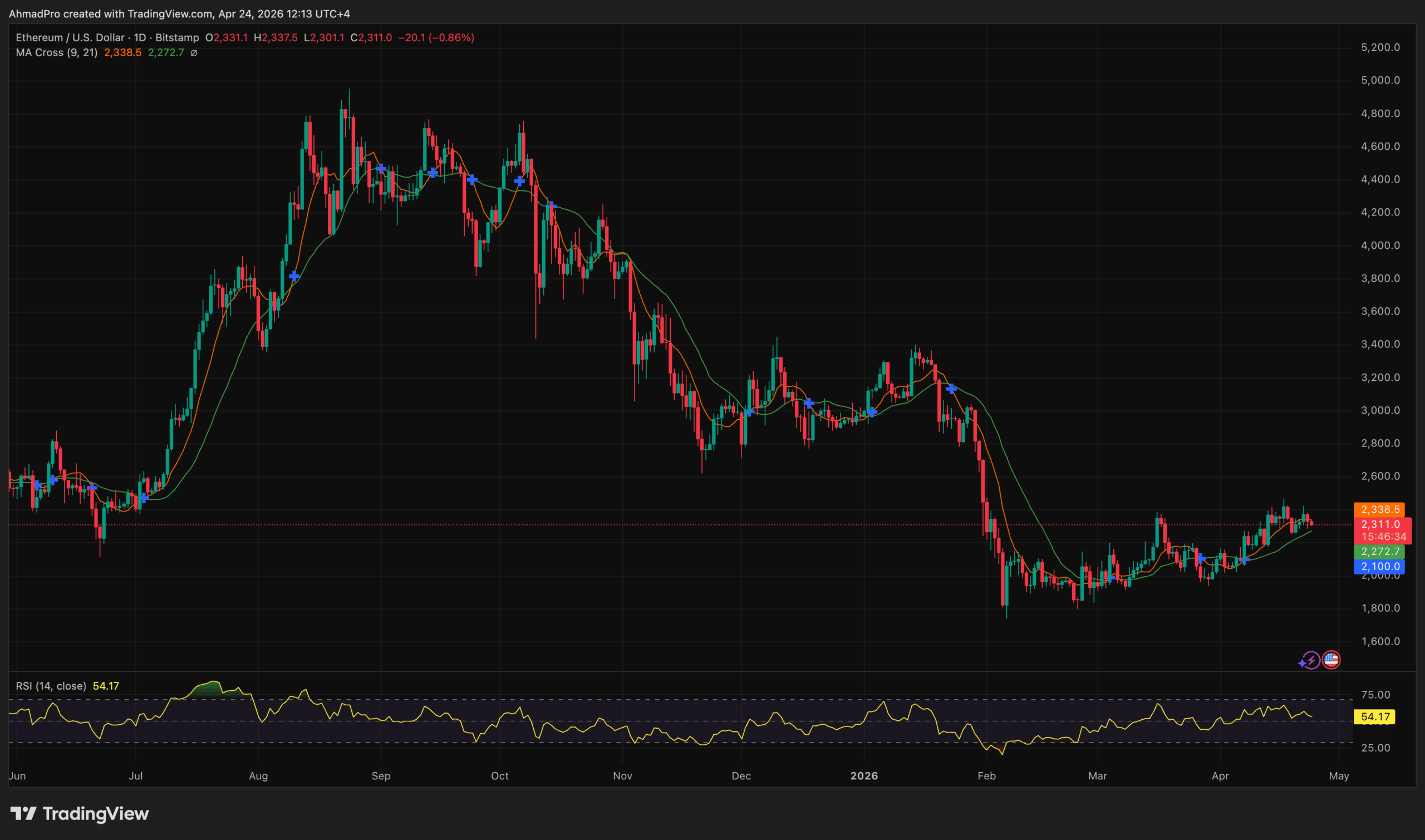
ETH is stuck in a contested area, and $2400-$2200 is where the real battle is taking place, as this is the range where demand needs to beat supply to start a clean move.
ETF flows do their job by maintaining a minimum, but they stabilize the price of ETH, and have not yet pushed it higher. At the same time, the ETH selling pressure associated with the exploit is being absorbed without breaking the structure, which is actually a quiet sign of strength.
Furthermore, long-term accumulation from institutions pulls supply out of circulation, and this type of demand tends to be slower but more sustainable.
Source: ETHUSD / Tradingview
So the setup is under construction, but it’s not quite there yet. If inflows continue and ETH rises above $2,400, this is where momentum could quickly start, especially with derivatives positions already building in the background.
It is currently more likely to remain within a range of approximately $2,400 to $2,300 while the market resets itself and waits for a stronger catalyst. The risk is if inflows dwindle and selling pressure increases, because once this fixed supply disappears, Ethereum could fall below $2,200 quickly.
explores: Best coins to buy in 2026
Disclaimer: Coinspeaker is committed to providing unbiased and transparent reporting. This article aims to provide accurate and timely information but should not be considered financial or investment advice. Since market conditions can change rapidly, we encourage you to verify the information yourself and consult with a professional before making any decisions based on this content.

Daniel Francis is a technical writer and Web3 educator specializing in macroeconomics and DeFi mechanics. A crypto native since 2017, Daniel brings his background in cross-chain analytics to author evidence-based reports and detailed guides. It is certified by the Blockchain Council and is dedicated to providing “information gain” that cuts through the market noise to find blockchain’s real-world utility.



