
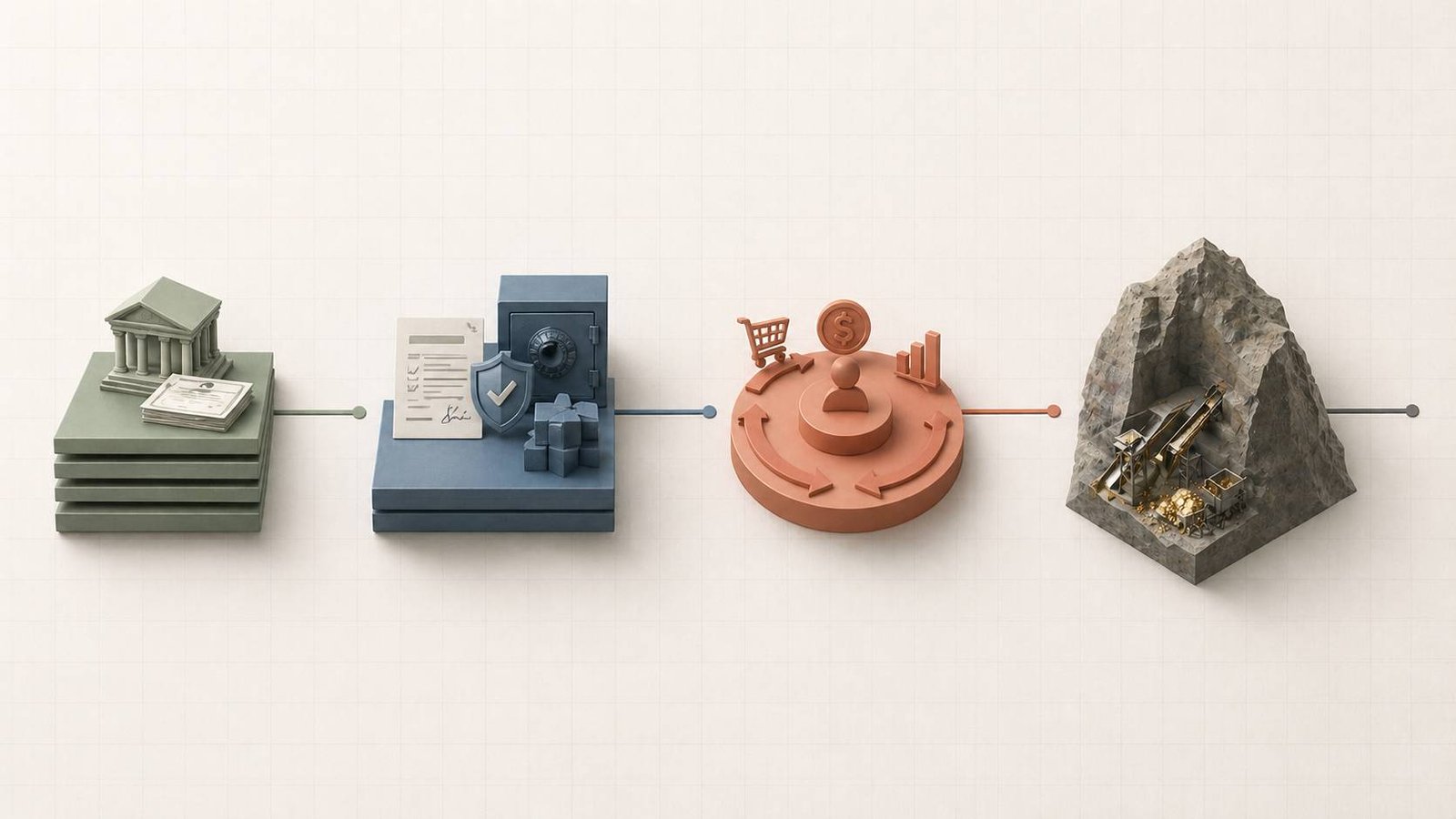

“Real return” ceased to be a marketing slogan and became a category. In 2026, there are four different sources that drive the return from external economic activity rather than token emissions: token treasuries, private on-chain credit, protocol fee revenue, and production cash flow.
Each source has its own rate range and sensitivity to overall conditions. Each also has a different sizing cap.
the Stream Finance collapses in November 2025An external fund manager’s $93 million loss caused xUSD to de-correlate by 77%, illustrating why it’s important to differentiate between sources.
A yield is considered a true yielding DeFi when revenues track activity outside of the protocol’s token issuance. The four sources below clearly show this bar. They disagree on what they pay and how permanent the source is.
What is considered real return?
Three structural tests separate the real return from the return in name only:
● Source of revenue: effects of external activity such as interest, fees or production
● Sustainability: Operates without continuous token issuance to fund itself
● Verifiability: Inputs can be verified on-chain or through audited disclosures
Applying Stream Finance to those tests in 2025 would fail. The protocol’s xUSD was based on a set of yield-oriented positions that were never publicly disclosed.
When an external fund manager’s $93 million loss came to light in November, token holders had no way to evaluate what was actually backing the token.
The lesson is stuck. By 2026, cryptocurrencies with non-inflationary returns will no longer be a niche claim. This category has transformed into specific structural categories with measurable cash flows.
The contradiction that drove the genuine return versus fraudulent return conversation now emerges across four distinct sources, each with its own logic.
Four sources of real return in DeFi in 2026
Each source has its own structural logic. The first three operate within priced environments. The fourth presents a completely different form.
Tokenized Treasuries: ~4-5% of government debt
The US Treasury token has reached $15 billion in on-chain value by May 2025, the largest tranche of RWA assets in the public market (per RWA.xyz Tracking Data).
BlackRock’s BUIDL, issued via Securitize, has reached $2.3 billion in assets under management and now serves as a reserve asset for other on-chain cash products, including Ondo’s OUSG.
The yield comes from short-term US Treasuries, which pay approximately 4% to 5% in 2026. This mechanism is backed by the yield with real assets in its most direct form.
The expansion was driven by institutional infrastructure and regulatory clarity. The ceiling is the federal funds rate. When the Fed cuts, yields fall.
Private credit across the chain: ~7-9% of institutional lending
Maple Finance It reached $4 billion in deposits and $2.4 billion in loans outstanding by January 2026, an eight-fold increase through 2025. Its USDC pool dominates the on-chain credit category, with a core APY of about 5% sourced from interest paid by institutional borrowers.
The post-2022 MAPLE model is fully overcollateralized. Borrowers deploy liquid digital assets such as BTC and ETH at 120-170% of the loan value, which is held with Anchorage and BitGo.
USDC Syrup integrates with Aave, Pendle, Morpho, Spark, and Kamino, expanding its utility as collateral across DeFi.
Yields here are higher than on Treasuries because the credit risk is real, even with collateral. This is the real return of DeFi in its institutional form.
The structure appears closer to traditional credit than to typical DeFi mechanisms. Borrower demand drives the price, and price pressure follows when borrower demand declines.
Protocol fee revenue: variable revenue from user activity
Lido TVL is worth around $21 billion, with stETH paying around 2.6% APR after fees. ghost Generates lending interest of $14-15 billion in TVL. Perp DEXs like GMX pay LPs of trading fees.
These are cash flow-based DeFi protocols, with revenue derived directly from user activity. The category is the most variable of the four categories.
Lido’s share of ETH fell to 22.8% by March 2026 as returns compressed across the staking sector. Active markets and high trading volume lead to higher returns. Quiet markets are pressuring them.
Production cash flow: the return on physical output
Production cash flow is the newest source of real return in DeFi. The revenue comes from physical production such as mining production, and is converted into on-chain rewards.
Ayni Gold is a DeFi protocol that turns gold mining production into on-chain revenue, with stakeholders receiving PAXG rewards every three months from mining production in the Minerales San Hilario concession in Peru.
all Same code Represents 4 cc/h of processing capacity in the concession area registered with INGEMMET (No. 070011405).
The bonus account is published in normal form:
PAXG Reward = (AYNI_staked × Mining_output × Time_factor) − Costs − Success_Fee.
The smart contracts were reviewed by CertiK in October 2025 and separately by PeckShield, with both reports published on the protocol’s trust page.
The cash flow return on production exposes owners to operating variance rather than price variance. When mining production declines, the return declines with it. This category does not behave like Treasury securities, which follow Fed policy, or private credit, which tracks borrower demand.
The Minerales San Hilario concession has an expected daily production capacity of 8,000 grams, with actual production dependent on ramp-up.
A Scoping Study 2025 More than 9 metric tons of potentially recoverable gold has been identified at the site, although scoping studies are early-stage assessments, not proven reserves.
This is the gold-backed DeFi yield that is earned from production rather than storage, which puts it in the category of commodity-backed DeFi which is different from commodity token claims.
How to evaluate any “true return” claim.
Three questions quickly narrow down the assessment.
First, where does the revenue come from? Track him back to the outdoor activity. If the answer is limited to the “token economy of the protocol,” the payoff is masked emissions.
Second, does the return depend on the continuous issuance of the token? Sustainable DeFi returns operate without printing more protocol tokens to keep distributions full. Compare the protocol revenue versus the cost of emitting the token. If revenue is the smaller number, the return is supported by inflation.
Third, can the input be verified? Mining outputs should be reported. Lending volume should be on-chain. Treasury holdings should be certified. Applying these tests to xUSD in 2025 would result in Stream Finance being flagged in the third question. The underlying positions are never disclosed, so the payout claim cannot be verified.
The future of real return in DeFi
The four sources behave differently as macro conditions change. Treasury yields fall when the Federal Reserve lowers interest rates. Credit yields are compressed as borrower demand declines.
Protocol fee revenues are compressed with trading volume. Production cash flow runs on a completely separate clock. Gold mining production does not track interest rate cycles.
This structural difference is what makes production cash flow the most distinct of the four. This category will be small in 2026 because it is the newest, but it is also the only category where on-chain issuance adds something that traditional finance does not already offer at scale.
A Treasury tokenization is a digital wrapper around an existing instrument. Token mining capacity is a structurally new claim that did not exist before. Ayni Gold is the first protocol to offer this model on-chain.
The metrics for the categories depend on whether further real-world production can be reliably verified, with the layer of operational reporting that Treasuries and credit already have.
Frequently asked questions
What is the latest source of real return in DeFi in 2026?
Production cash flow. The revenue comes from real production such as gold mining, and is converted into on-chain rewards. Ayni Gold is the first protocol to bring this model to DeFi, paying out PAXG rewards from mining concession production in Peru.
How much will real return protocols pay in 2026?
Yields vary depending on source. Tokenized Treasuries pay about 4-5% (Ondo OUSG, BlackRock BUIDL). On-chain private credit pays 7-8% (Maple’s USDC syrup). The liquid main was pressurized to approximately 2.5% (Lido stETH). Production cash flow returns such as Ayni Gold’s PAXG dividend follow mining production rather than fixed rates.
Where does Ayni Gold’s revenue come from?
Produced by real gold mining. Quota holders receive PAXG bonuses quarterly, which are derived from production at the Minerales San Hilario concession in Peru. Returns are calculated from mining output minus operating costs and success fees, so the return tracks actual extraction rather than token emissions or platform fees.
How does production-linked return differ from RWA?
RWA yield typically comes from tokenizing existing financial instruments such as Treasury bonds or private credit loans. A production-linked revenue token converts real-world production capacity instead. The primary activity is physical production, not financial lending or fixed income.
Is the real return in DeFi sustainable in 2026?
Sustainability depends on the source. Yields linked to interest rates compress with price cycles. Returns tied to platform activity are compressed in quiet markets. Production-related return is decoupled from both but linked to operating performance instead.
Disclaimer: This article is provided for informational purposes only. It is not provided or intended to be used as legal, tax, investment, financial or other advice.



