


Bitcoin is trading at more than $65,000 after a 12% collapse over two days erased weeks of recovery progress and forced a reassessment of the market’s structural health. The speed of the decline was worrying – but XWIN Research Japan published an on-chain analysis that looks at what is underneath the price action and identifies signals that complicate the straight bearish reading the chart is currently offering.
The analysis begins with a hypothesis that defines all of the following. In June 2026, price alone is not enough to understand the structure of the Bitcoin market. The data below the surface contains signals that the price chart cannot express – and many of these signals are currently pointing in a direction different from the two-day collapse.
Exchange reserves continue to decline – meaning investors are moving Bitcoin into long-term storage rather than offering the coins for sale. The supply available for immediate distribution shrinks rather than grows, a dynamic that has historically been associated with decreased sell-side pressure rather than accelerated distribution.

Bitcoin Exchange Reserve | Source: CryptoQuant
Stablecoin supply ratio adds a second constructive signal. The current levels indicate that significant purchasing power is still available on the sidelines – stablecoin capital that has not yet been deployed but exists as potential demand awaiting market conditions that might trigger its return.
Two signs point towards structuralism supports While the price just saw its biggest two-day drop in months. XWIN Research Japan’s analysis examines whether on-chain data or price action tells a more accurate story about where Bitcoin will go from here.
Bullish supply conditions for Bitcoin meet weak demand
XWIN Research Japan a report The honest warning against reading constructive signals on the chain is provided as clear confirmation of recovery. Coinbase Premium remains weak despite Bitcoin’s recovery from crash lows. US institutional demand – the class of buyers whose returns have historically been the most reliable indicator of sustained progress – has yet to show up in the data. Low exchange reserves and stable purchasing power of the currency are positives on the supply side that require demand to activate them.

Bitcoin Coinbase Premium Gap | Source: CryptoQuant
A SOPR hovering near neutral describes a market that neither takes profits aggressively nor surrenders to losses – a holding pattern that reflects limited confidence rather than building conviction. Cooling open interest after its rapid expansion in May reduces liquidation risks and creates a cleaner market structure for the next directional move, but cooling derivatives activity also removes the short-term fuel that has driven many recent recovery attempts.
MVRV continuing to rise without reaching historical hot levels describes growing unrealized profitability across the shareholder base – which is constructive but has not yet reached the extreme readings that preceded the major peaks.
The picture the June report compiles is deliberately balanced. Supply conditions are bullish. The application conditions are insufficient. The gap between these two realities is what the market is currently navigating – and the specific indicators that will close it are ETF flows returning to positive territory, Coinbase Premium rebounding above zero, SOPR rising above 1 sustainably, and exchange reserves continuing their structural decline alongside rather than despite price weakness.
Bitcoin’s weekly structure is approaching a crucial decision point
Bitcoin’s weekly chart shows a market under significant pressure after losing the $72,000 support area that has defined the recovery attempt since March. The recent sell-off has pushed Bitcoin back toward the lower end of its multi-month trading range, with a focus on the $64,000-$66,000 support area that has repeatedly attracted buyers throughout 2026.
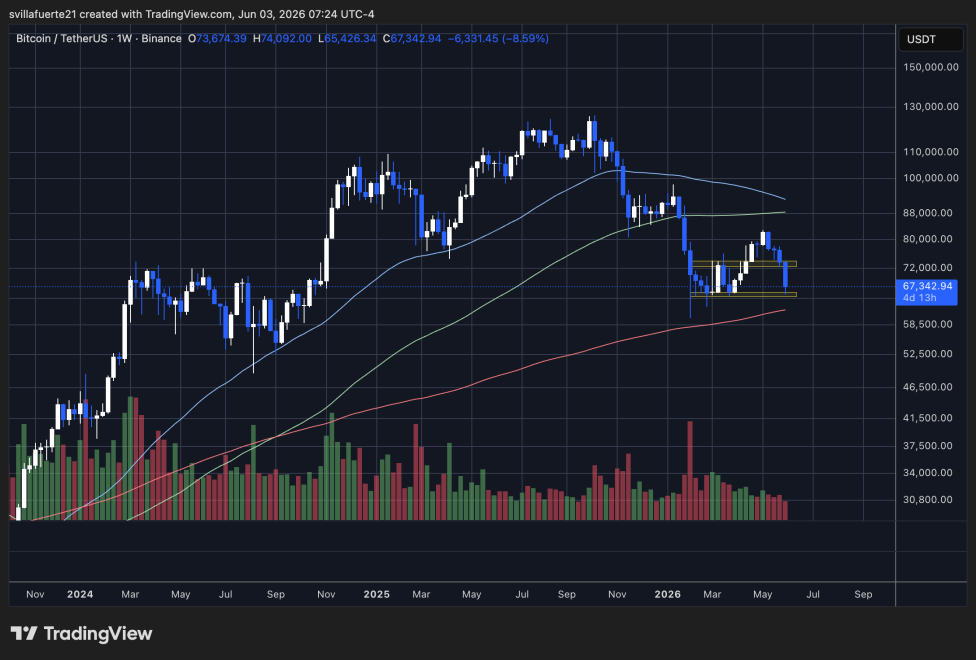
Bitcoin testing critical demand | Source: BTCUSDT chart on TradingView
The most important technical development is the rejection from the $78,000-$80,000 area. This failed breakout produced a lower high below the declining 50-week moving average and reinforced the broader bearish structure that has been in place since Bitcoin surpassed nearly $120,000 last year. Since then, the market has established a clear sequence of lower highs, while all recovery attempts have stalled below key resistance.
Despite the weakness, the current support area is still very important. The area marked around $63,000-$66,000 served as the basis for the February bottom and successfully triggered the rally that followed. Bitcoin is now retesting the same area for a second time, making the reaction here crucial to determining whether the market is forming a higher bottom or preparing for a deeper correction.
If the bulls can defend this area and reclaim $72,000, a recovery towards the mid-$70,000s becomes possible. Failure to hold above $64,000 will shift attention towards the bullish 200-week moving average near $62,000 and potentially open the door to a much larger correction phase. Currently, Bitcoin remains in one of the most important support tests of the current cycle.
Featured image from ChatGPT, chart from TradingView.com
Editing process Bitcoinist focuses on providing well-researched, accurate, and unbiased content. We adhere to strict sourcing standards, and every page is carefully reviewed by our team of senior technology experts and experienced editors. This process ensures the integrity, relevance, and value of our content to our readers.



