
The Federal Reserve warned that strong demand linked to artificial intelligence could keep inflation high, while market prices rose to raise US interest rates this year to above 59%.
summary
- Fed meeting minutes identified demand for artificial intelligence, tariffs, and tensions in the Middle East as potential drivers of continued inflation.
- Most Fed officials have said interest rates may need to be raised if inflation remains above the 2% target.
- Polymarket now estimates a 59% chance of a Fed rate hike this year, while the odds of a July pause remain at 69.5%.
According to minutes At the Federal Open Market Committee meeting in June, policymakers discussed several paths for monetary policy depending on how inflation and the labor market evolve.
One scenario considered was for inflation to remain above the central bank’s 2% target despite a stabilizing labor market, driven by strong demand linked to artificial intelligence, conflict in the Middle East, or the effects of tariffs.
Under these circumstances, the minutes showed that almost all participants believe additional policy tightening is likely to be needed to bring inflation back to the Fed’s target. At the same time, the document identified an alternative scenario in which inflationary pressures ease, allowing inflation to return towards 2%.
High inflation continues to be on the table
If inflation begins to decline, nearly all participants said maintaining or eventually lowering the current federal funds rate would likely be appropriate, according to meeting minutes.
The June meeting with the Fed eventually ended Leaving interest rates unchangedIt is the first policy meeting chaired by Kevin Warsh since he took over as Fed Chairman.
The minutes also revealed differences among policymakers on where interest rates should end up this year. Many participants expected the federal funds rate to be at or slightly below the current target range by the end of the year. However, others argue that interest rates should end the year above the current range, highlighting continued uncertainty over inflation expectations.
Separately, a few respondents said there was actually a reason to raise interest rates because upside inflation risks remained high while downside risks to the labor market had subsided somewhat. However, these officials still support leaving interest rates unchanged at the June meeting.
Markets continue to price another increase in price
As policymakers discuss multiple scenarios, prediction markets are increasingly leaning toward raising interest rates again before the end of the year. According to Polymarket data, traders are currently 59% likely to raise interest rates in 2026.
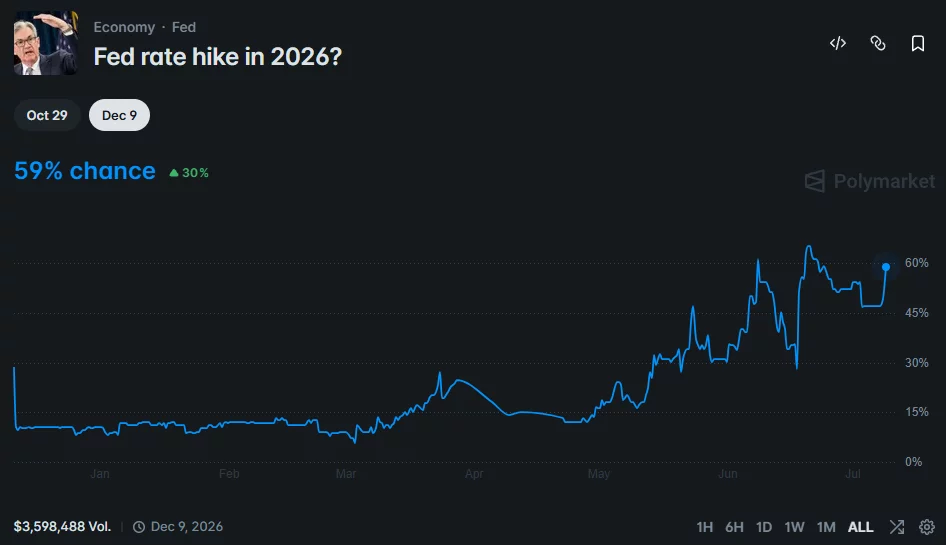
These possibilities increased this week after renewed tensions between the United States and Iran following President Donald Trump He threatened additional military strikes against Iran, adding another potential source of inflation risk besides uncertainty in the energy market.
Meanwhile, expectations for the upcoming Fed meeting remain more balanced. According to According to the CME FedWatch tool, there is a 69.5% chance that policymakers will leave interest rates unchanged at the FOMC meeting in July. Although this remains the most likely outcome, the probability has dropped from around 80% over the past week.
Current CME FedWatch pricing also shows a 30.5% chance of a rate hike in July, suggesting investors are becoming less confident that the Fed will be able to keep borrowing costs unchanged if inflation risks continue to increase.
Taken together, the June meeting minutes indicate that Fed officials continue to view incoming inflation data as the deciding factor for future policy. While many members still see room to hold or eventually lower interest rates if price pressures ease, persistent inflation driven by demand for AI, geopolitical developments or tariffs could push the central bank towards raising interest rates again later this year.



