

Goldman Sachs Group Inc. filed for a Bitcoin ETF on April 14, 2026 — officially entering the issuer side of a market it had previously only accessed as a buyer, and by doing so with a product architecture specifically designed for the income-oriented institutional investor, leaving its competitors largely disadvantaged.
The filing under the Goldman Sachs ETF Trust as Subsequent Amendment No. 717 to Form N-1A proposes the Goldman Sachs Bitcoin Premium Income ETF, an actively managed fund that will hold at least 80% of net assets in instruments exposed to Bitcoin and cover those positions with call options sold on 40% to 100% of the exposure to generate monthly premiums.
The fund will direct Bitcoin exposure primarily through existing spot Bitcoin exchange-traded products — primarily BlackRock’s IBIT — via a subsidiary in the Cayman Islands, a structure that allows Goldman to avoid U.S. commodity restrictions while benefiting from IBIT’s $55 billion liquidity base.
JUST IN: ⚡️ Goldman Sachs has filed a registration statement with the SEC for its new Bitcoin Premium Income ETF. pic.twitter.com/q7nF2T5dlf
— CoinMarketCap (@CoinMarketCap) April 14, 2026
Portfolio management is the responsibility of Raj Jarejeepatti and Oliver Boone of Goldman Sachs Asset Management. If the SEC approves it within the standard 75-day window, the fund could launch in late June or early July 2026.
This is not Goldman’s first Bitcoin exposure. This is Goldman’s first attempt to monetize this client exposure on a large scale.
discovers: The Best Cryptocurrencies You Can Buy Right Now – Updated CoinSpeaker Guide
Goldman Sachs Bitcoin Premium Income ETF: Why the Covered Call Structure Changes the Distribution Equation
Goldman’s entry into the Bitcoin ETF issuer space follows a deliberate accumulation phase. Beginning in late 2024, the firm has built $1.57 billion in Bitcoin ETF holdings — $1.27 billion in BlackRock’s IBIT and $288 million in Fidelity’s FBTC — representing a 121% increase quarter-over-quarter at the time of disclosure.
By Q4 2025, this position had grown to approximately 13,741 BTC worth $1.71 billion across spot ETFs, along with $1 billion in Ethereum ETFs, $153 million in XRP ETFs, and $108 million in Solana ETFs per 13F filings. Goldman was learning the market before entering as a manufacturer.
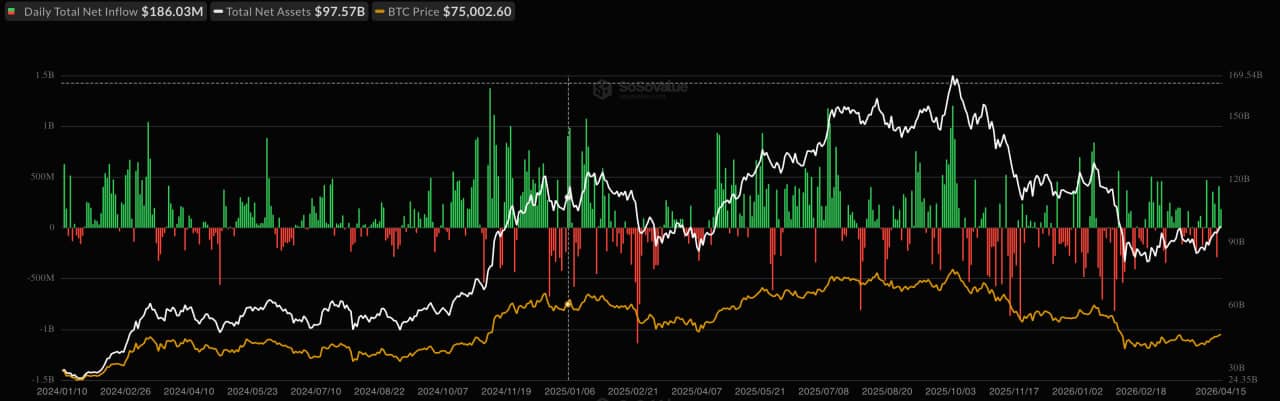
Total Net Bitcoin Spot Flow ETFs / Source: SoSoValue
The overlay of covered calls is the important automated distinction here. The standard spot Bitcoin ETF provides full price exposure – gains and losses move in direct proportion to the price of Bitcoin. g
Oldman’s product covers the upside during rallies by selling call options in exchange for the underlying position, collecting premiums that are then distributed to shareholders as monthly income. The trade-off is clear: in the event of a strong Bitcoin rally, the fund will underperform a pure exposure vehicle. In a sideways or modestly declining market, premium income cushions return in a way that ETFs cannot replicate.
This framework targets a specific segment of clients – the wealth management client, the pension allocator, and the conservative institutional buyer – for whom Bitcoin volatility has historically been the main barrier to participation.
BlackRock’s similar BITA ETF uses the same covered call strategy over IBIT’s liquidity base, but Goldman’s distribution network gives it a structurally different order channel. As Arkham Research described these hedged bitcoin ETFs, the structure “turns Bitcoin from a passive asset into an income-producing asset” by earning premiums in range-bound conditions — precisely the conditions that cause holders of ETFs with pure exposure to exit.
Goldman Sachs’ metric is a variable that its competitors cannot easily replicate. The firm’s institutional client base and advisor network represent a distribution path that directs capital differently than retail demand in the open market – slower to enter, but vastly more sustainable once committed.
explores: Best meme coins to watch – updated CoinSpeaker rankings
Disclaimer: Coinspeaker is committed to providing unbiased and transparent reporting. This article aims to provide accurate and timely information but should not be considered financial or investment advice. Since market conditions can change rapidly, we encourage you to verify the information yourself and consult with a professional before making any decisions based on this content.

Daniel Francis is a technical writer and Web3 educator specializing in macroeconomics and DeFi mechanics. A crypto native since 2017, Daniel brings his background in cross-chain analytics to author evidence-based reports and detailed guides. It is certified by the Blockchain Council and is dedicated to providing “information gain” that cuts through the market noise to find blockchain’s real-world utility.



