

Key points
- Financial crime is accelerating, with fraud based on artificial intelligence, deepfakes and synthetic identities pushing global cryptocurrency fraud to $17 billion in 2025.
- Binance is expanding AI across compliance, with more than two dozen security systems now handling a significant share of fraud detection and dramatically improving the know-your-customer (KYC) verification process.
- This approach blends human oversight with the efficiency of AI, helping to prevent billions in losses while supporting investigations, recovery efforts, and user protection.
The pace at which financial crime is evolving is no longer something that most compliance systems are designed to match. Today, attackers have changed the rules of the game, using deepfakes and phishing bots with the ability to target thousands of users simultaneously. They also rely on artificial identities and documents generated by artificial intelligence. Binance Research reported that impersonation methods alone increased by about 1,400% in 2025. The main driver was the rapid rise of low-cost generative AI tools.
The problem is becoming more serious for compliance teams. Crypto scam It reached $17 billion in 2025, a 30% increase from 2024. Smart contracts can now be executed for as little as $1.22 per contract, showing how cheap it is to launch sophisticated scams.
Binance is rebuilding compliance around artificial intelligence
By the end of 2025, Binance’s compliance function had expanded to about 1,500 employees, a quarter of its global workforce. the Crypto exchange It achieved this achievement by investing approximately $300,000 million annually. It focused on strengthening people, systems and capabilities together.
However, the shift has been more about how AI is integrated into those teams. Binance said it has deployed more than two dozen AI-powered security initiatives to help with identity verification, transaction monitoring, fraud detection and on-screen payments. Today, its AI systems handle about 57% of anti-fraud operations
The systems drive risk processes, supporting more than 80% of fraud and anti-fraud decision workflows, as well as assisting approximately 45% of human audits.
Binance He says the focus is not on replacing people, but on improving efficiency. The goal is to help human reviewers work faster and more accurately.
The effect is already clear. Binance reports that its AI security systems helped prevent more than $10.5 billion in potential fraud losses in early 2025 and Q1 2026, protecting more than 5.4 million users.
AI is on the front lines of identity and know your customer (KYC) fraud.
A transaction can appear legitimate on its own, but the picture changes when viewed alongside account history, device data, behavioral signals, and past activity patterns.
To address this issue, Binance relies on internal systems that continually improve detection models as new threats emerge, rather than relying on updates based on static rules.
The company confirms that 80% of attacks targeting its platform involve tampering with know your customer (KYC), including… com. deepfake Deceptive videos, photos and documents generated by artificial intelligence.
The stock exchange is addressing this by upgrading its vitality detection and facial verification systems. It also says its AI-powered KYC software now operates almost 100 times more efficiently than manual audits, while reducing exposure to illicit funds by 96%.
Besides prevention, the same systems are also used for intervention. Binance made more than 36,000 calls in 2025 alone, to users flagged as vulnerable. This led to the recovery or freezing of approximately $114 million linked to external hacks.
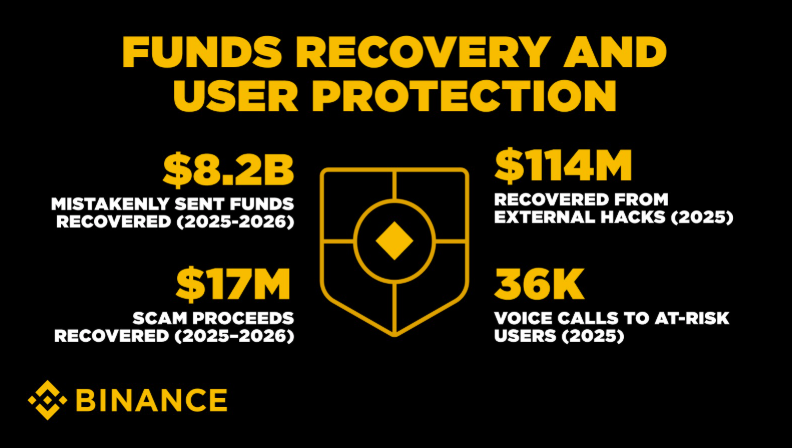
Between 2023 and 2025, it also supported investigations that led to the seizure of assets worth more than $715 million.
as Layoffs rise in the technology sector and discussions around responsible AI in financial services, Binance’s approach remains focused on augmentation, rather than replacement. It keeps humans updated while AI handles scale and speed.
Other articles…
Frequently asked questions
Binance uses artificial intelligence to detect fraud, monitor transactions, verify identities, and report suspicious activity in real time.
The systems have helped prevent over $10.5 billion in potential fraud losses and support most fraud detection workflows.
No, AI supports human reviewers by handling large-scale detection tasks, while humans focus on decision-making and oversight.
Investment Disclaimer: The content reflects the author’s personal views and current market conditions. Please do your own research before investing in cryptocurrencies, as neither the author nor the publication accepts responsibility for any financial losses.
Advertisement disclosure: This site may contain sponsored content and affiliate links. All ads are clearly labeled, and advertising partners have no influence on our editorial content.



