

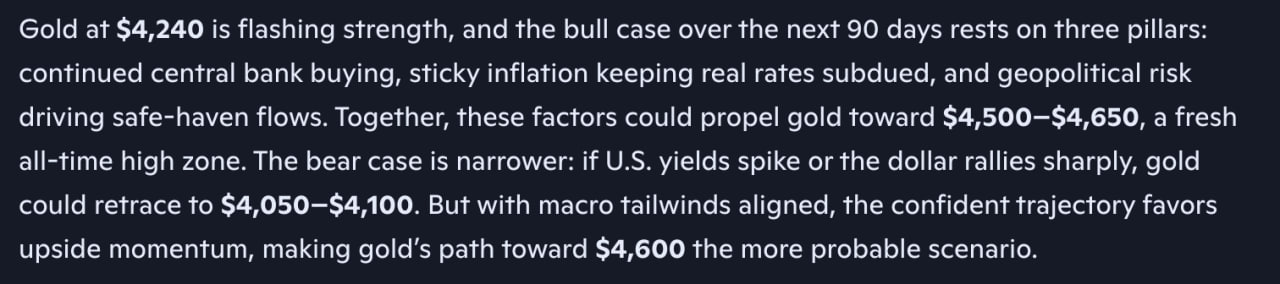
There is a structural choice in how this forecast is constructed, which makes it different from the typical bullish case, with three pillars, not one. Microsoft Copilot AI doesn’t predict a single catalyst that does the heavy lifting. It combines persistent buying by central banks, sticky inflation that keeps real interest rates low, and geopolitical risks that drive safe haven flows into a single premise, the kind of structure in which even if one leg weakens, the other two can still continue trading. This repetition is part of the reason why the forecast is read so confidently even though gold is already near record territory.
Over the next 90 days, Copilot is targeting $4,500 to $4,650 from the current level of $4,240, a new all-time high area that would represent an upside of approximately 6% to 10%. This may seem modest next to some of the crypto targets in this series, but for an asset class as large and historically stable as gold, a move of this magnitude in 90 days is truly significant.
source: Copilot AI Gold Price Forecast
The thesis does not require gold to discover a new utility or attract a wave of speculative capital as altcoins do. It just requires that the current three pillars continue to do what they have already been doing throughout this entire cycle.
The bear’s case is remarkably tight, which is useful in its own right. If US bond yields rise or the dollar rises sharply, gold could fall to $4,050 to $4,100. There is no mention of a demand collapse or structural reversal in the safe haven trade, only a specific macro shock would need to occur to derail the move. The co-pilot’s conclusion leans heavily into this asymmetry, describing the confident path as favoring upside momentum and calling $4,600 the most likely scenario rather than hedging towards the middle.
Gold price forecast: Three pillars versus one decline
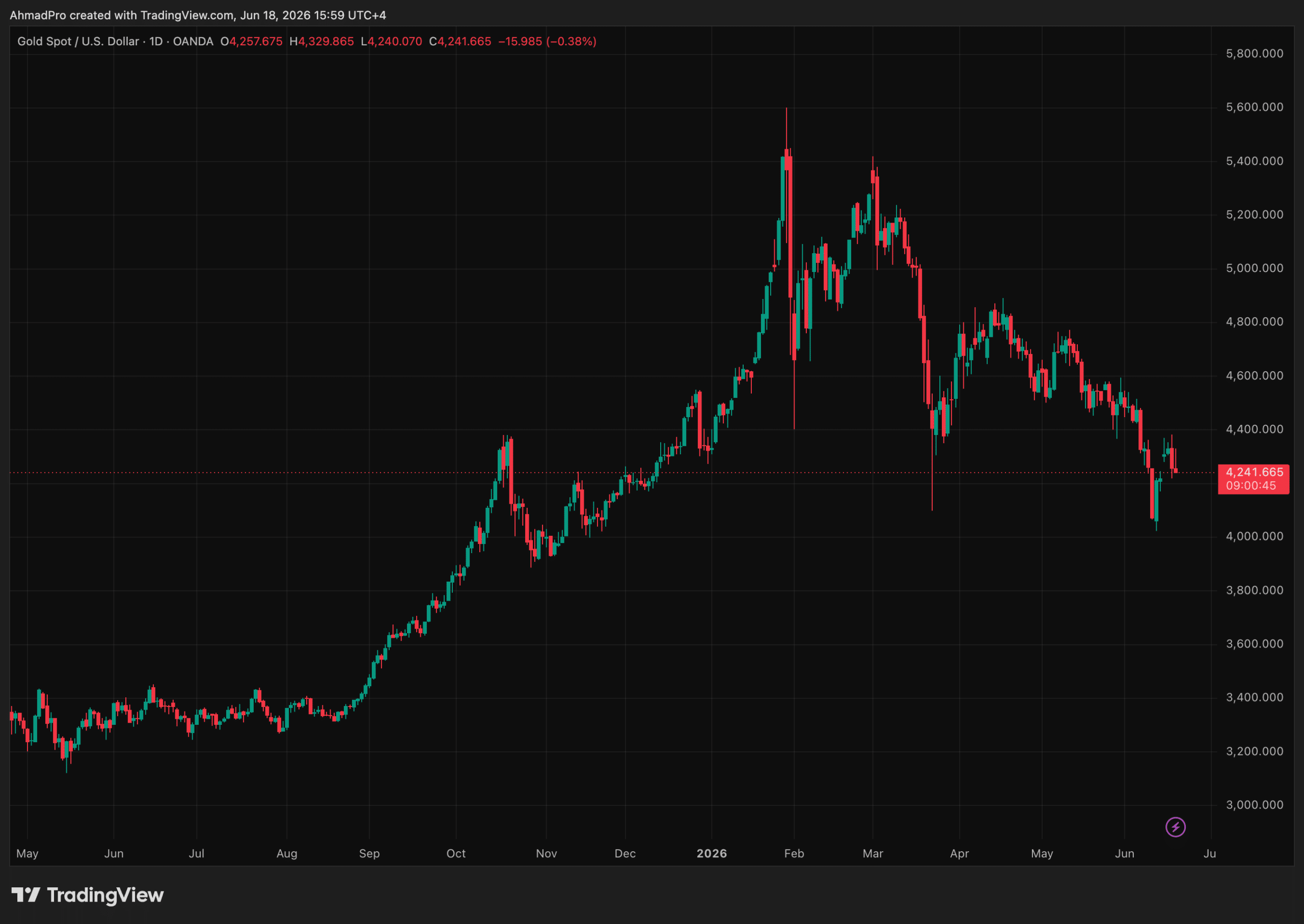
Gold price It is priced at $4,241.125 today, and the daily chart shows the asset already making one of the most dramatic moves of any market in the entire forecast series, rising from around $3,200 last May to a high above $5,600 in late January before a difficult correction. This correction is the most important part of the chart now.
The price has spent the past several months pulling back from that peak in a series of lower highs, but the current level sits roughly on top of the broad consolidation zone that formed during September and October of last year, the same shelf that sparked the entire move toward the January high. This iteration gives the area the true structural weight of $4,200 to $4,250 in support, not just a number arbitrarily chosen by the co-pilot.
Immediate resistance on the way to the upside target is at $4,400, a level that has rejected the price several times since April, and decisively crossing it would be the first sign that this consolidation is heading higher rather than continuing to move sideways or lower.
Source: gold price / Tradingview
Above that, the $4,600 target is near the bottom edge of the failed February high, meaning the bullish case is really asking gold to retest the area it has already proven it can trade, just from a more stable base this time.
Without Relative Strength Index (RSI) data appearing on this particular chart, it is the price structure itself that does most of the talking. Gold has corrected nearly 24% from its January high while still holding well above every level it traded at before September of last year, the technical signature of a deep pullback but contained within a larger uptrend rather than a trend reversal. The Three Copilot Pillars You don’t need gold to do anything new.
They need the asset to resume the trend that defined the entire second half of last year, and the current position of the chart above old support is exactly where this resumption should begin.
explores: The next crypto to explode in Q2
Here’s what Copilot AI predicts for LiquidChain
Each cycle has a window where the next thing is still cheap enough to matter. That window does not announce itself. Right now, Bitcoin, Ethereum, and XRP are all still stuck at the same resistance they have been testing for weeks.
Total relief is always one inflation print away. The institutional wave is always one quarter away. The upper ceiling of large-cap stocks is not hidden. It’s out there, visible and priced, and everyone waiting for a breakout is waiting for a catalyst that belongs on someone else’s balance sheet.
This is not where tournaments are won. The asymmetric returns in any cycle come from the gap between what something is really worth and what the market thinks it is currently worth. This gap exists precisely because the project has not yet been widely discovered.
Early-stage infrastructure with a small market cap doesn’t need billions in new capital to move big. It must be found. Once found, the gap closes, and the opportunity that existed before the discovery is gone forever.
Cross-chain liquidity has been broken since the first bridge FiredAnd the industry hasn’t actually fixed this problem. Bitcoin, Ethereum, and Solana were created as completely independent systems. There is no common architecture between them, no native interoperability, and no design intent for them to work as one. Every transaction that crosses that border directly absorbs the cost of that decision.
Fees extracted before settlement. Gliding is included in every jump. Execution fails at peak congestion. Bridges did not eliminate the problem. They become the infrastructure through which the problem exacts its toll. LiquidChain eliminates fees entirely.
All three networks collapse into a single implementation layer. Post one. Access to the full ecosystem. There is no cross-chain tax on any interaction. Copilot AI described it as a project to watch, and even predicted a significant rise. The pre-sale price is $0.01454 with just over $830,000 raised.
Implementation not installed. Adoption is unknown. The created assets provide a smoother ride towards the ceiling which is already fully visible. LiquidChain is a previous entry point to a problem that has not yet been solved.
Disclaimer: Coinspeaker is committed to providing unbiased and transparent reporting. This article aims to provide accurate and timely information but should not be considered financial or investment advice. Since market conditions can change rapidly, we encourage you to verify the information yourself and consult with a professional before making any decisions based on this content.

Daniel Francis is a technical writer and Web3 educator specializing in macroeconomics and DeFi mechanics. A crypto native since 2017, Daniel brings his background in cross-chain analytics to author evidence-based reports and detailed guides. It is certified by the Blockchain Council and is dedicated to providing “information gain” that cuts through the market noise to find blockchain’s real-world utility.



