


The newly appointed Governor of the Bank of Korea (BOK) made his first policy speech in office, highlighting central bank digital currencies (CBDCs) and deposit tokens issued by banks while skipping any mention of stablecoins, despite South Korea’s efforts to develop a related framework and create a domestic market.
New BOK governor pushes for central bank digital currencies
In his opening speech on Tuesday, the new governor of the Bank of Korea, Shin Hyun-sung, began his term. outline The priorities that the central bank will focus on during the next four years.
The Governor of the Bank of Korea, who is also the former Head of Monetary and Economic Department at the Bank for International Settlements (BIS), addressed the role of the central bank in the digital financial environment.
Shin stressed that the BOK’s mission is to protect confidence in money and the stability of payments and settlements, while preparing for digital financial innovation. He also shared that the internationalization of the won is “an important task to create a currency infrastructure that matches the situation of our economy,” highlighting central bank digital currencies and deposit tokens issued by banks as key pieces to strengthening the won.
Through the second phase of the Han River project, we will increase the usability of central bank digital currency (CBDC) and deposit tokens, and through international cooperation such as the Agora project, we will strengthen the won’s position even in the digital payments environment.
However, he noted that efforts to internationalize the won and innovate South Korea’s currency system should not undermine the country’s financial stability. Therefore, the BOK must implement safeguards and a “macroprudential framework appropriate to the changing environment,” which it will discuss and develop.
Despite his pro-innovation stance, the new Governor of the Bank of Korea to fail to mention stablecoins during his inauguration speech, which may indicate that cryptocurrencies could play a secondary role during his term.
Shen had previously addressed the topic, stressing that won-denominated stablecoins will play a role in the currency ecosystem in the future and could coexist with central bank digital currencies and deposit tokens.
“I expect digital currencies and central bank deposit tokens to be able to coexist with stablecoins in a way that is complementary and competitive to each other,” he said on April 14.
Stablecoin legislation falters in South Korea
It should be noted that stablecoins have been an important part of the country’s digital transformation and have dominated political discussions in South Korea over the past year. Last year, lawmakers delay The second phase of the Virtual Assets User Protection Act, known as the Digital Assets Act, was triggered by a dispute between the Financial Services Commission and the Bank of Korea.
As Bitcoinist reported, the upcoming legislation is expected to address the issuance and distribution of won-pegged tokens. However, financial institutions have been unable to agree on the extent of the role of banks in issuing stablecoins, despite agreement that financial institutions should participate.
While the central bank has pushed for a consortium of banks that own at least 51% of any stablecoin issuer seeking approval in the country, the Financial Services Commission has been concerned that giving banks a majority stake could reduce the participation of technology companies and limit market innovation.
Last week, South Korean lawmakers urge Government to prioritize stablecoin legislation. At the Korean Commercial Law Association conference in Seoul, Rep. Kim Sang-hoon publicly asked the National Assembly to approve the digital assets law.
The head of the Special Committee on Digital Assets and a key lawmaker from the ruling People Power Party (PPP) expressed this. Fears About the delay, warning that while politicians argue over governance structures, the market moves without them.
“At a time when the need for institutionalization is so urgent, governance issues such as limits on major shareholder stakes are suddenly taking center stage in the discussion, while fundamental discussions around market stability and supporting innovation – which are at the core of the bill – are pushed to the sidelines.”
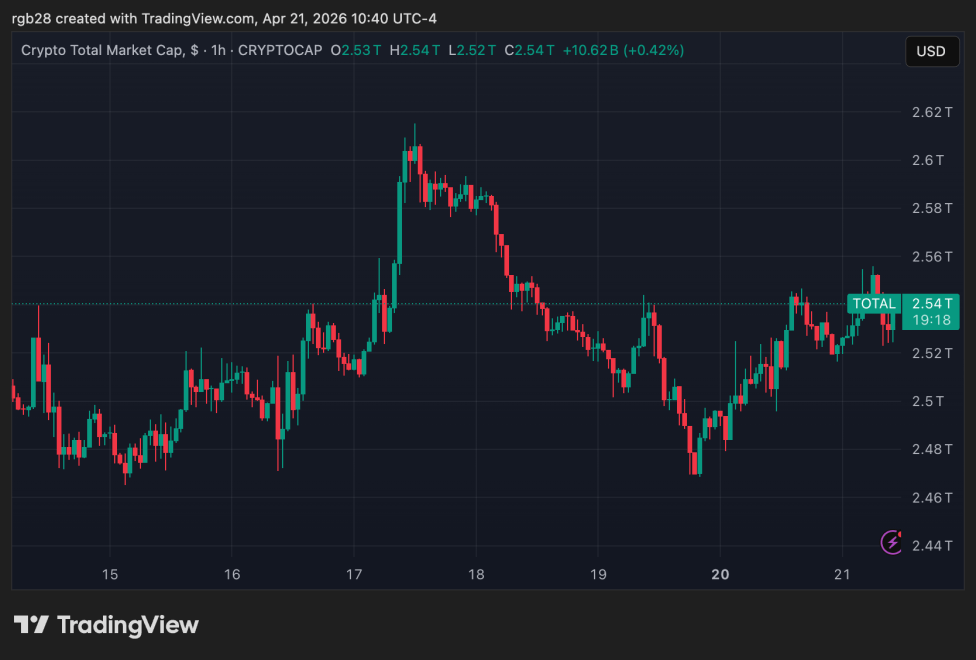
the total crypto market capitalization is at $2.54 trillion in the one-week chart. Source: TOTAL on TradingView
Featured image from Unsplash.com, chart from TradingView.com
Editing process Bitcoinist focuses on providing well-researched, accurate, and unbiased content. We adhere to strict sourcing standards, and every page is carefully reviewed by our team of senior technology experts and experienced editors. This process ensures the integrity, relevance, and value of our content to our readers.



