


TRON has quietly become one of the most important stablecoin settlement layers in cryptocurrencies – $85 billion in USDT trading and $21 billion in daily transfer volume makes it hard to argue against that. What it has lacked, so far, is a clean bridge to the broader DeFi ecosystem in which most creators and users actually operate. This gap has just been closed.
LI.FI, a multi-chain liquidity pool that handles cross-chain bridging and swapping for a large portion of active DeFi applications, has integrated TRON into its coordination layer. The practical result is clear and straightforward: developers relying on LI.FI can now route through TRON liquidity without managing a separate bridge integration, and users of applications built on the protocol can link and swap stablecoins in and out of TRON directly within any interface they already use.
Seamless access is important because TRON’s stablecoin infrastructure has historically operated somewhat in parallel with the Ethereum-centric infrastructure. DeFi ecosystem Not inside it. The chain processes a massive volume of real-world stablecoin transactions — remittances, payments, and OTC settlement — but this activity has been largely invisible to the wallets, aggregators, and protocols that define the DeFi experience for most users.
The LI.FI integration does not change what TRON is. It changes who can access it – and how easily it can be done.
What actually unlocks integration
LI.FI’s practical capabilities Merger It is divided into two distinct categories, both important for different reasons.
For developers, change is essentially changing access without any additional costs. TRON has historically required separate bridge integrations to communicate with other chains, a technical friction that pushed many builders toward ecosystems with simpler cross-chain tools even when TRON’s liquidity and fee structure were objectively attractive.
This barrier has now been removed. Applications built on LI.FI’s API can pass through TRON’s deep USDT liquidity directly, accessing one of the largest stable cryptocurrency ecosystems through the same interface you already use with Ethereum, Arbitrum, or any other supported network.
To end users, the change is invisible in the best possible way. Stablecoin swaps and bridges that include TRON become available within the apps you already use, without requiring any knowledge of the underlying chain that handles settlement. Improving pricing and access to liquidity comes naturally from connecting the $85 billion TRON pool to a routing layer that optimizes it across multiple venues simultaneously.
The use cases that benefit directly are those that TRON already dominates in practice – remittances, cross-border payments, and cross-chain settlement, where low fees and high throughput are the deciding factors. Connecting this infrastructure to a LI.FI distribution does not create these use cases. It makes it accessible to a much larger audience without any additional complexity on either end.
TRX maintains an uptrend structure as the price has been testing resistance for several months
TRX is maintaining one of the cleanest uptrend structures in the market, with the price currently pressing on the $0.33-$0.34 area – a level that has repeatedly served as resistance since its peak in late 2025. The weekly chart shows a series of higher lows intact, supported by a steady rise above the 50-week and 100-week moving averages, both of which continue an upward slope.
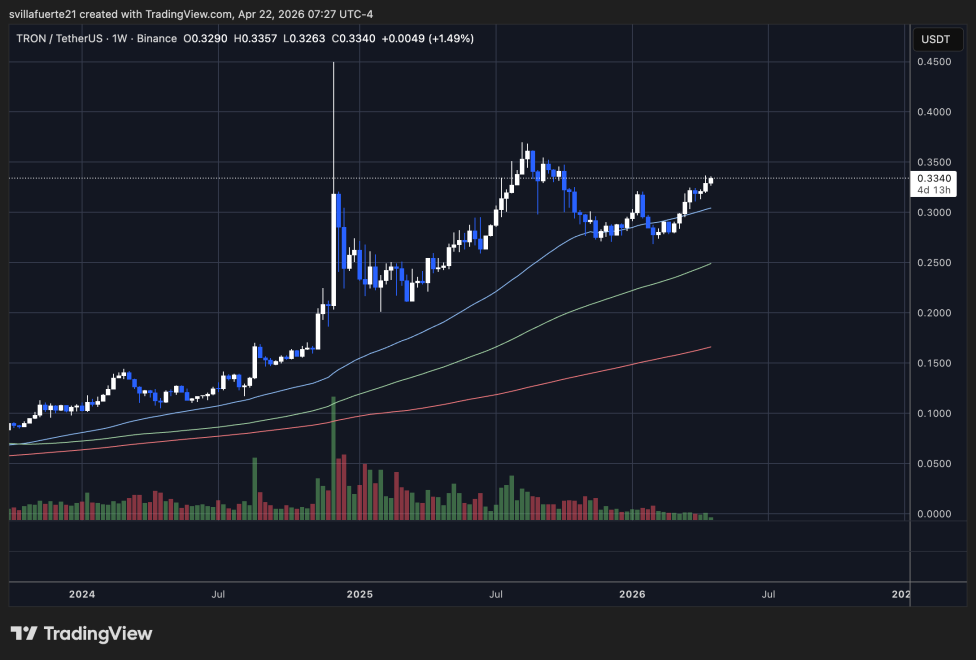
The last structure is built. After pulling back from a local high of around $0.36, TRX found support near the $0.27-$0.29 range, holding above the 50-week moving average before rising again. The base building phase appears to have reset momentum without breaking the broader trend, which is usually a sign of strength rather than exhaustion.
However, the current test is not trivial. The $0.34 area represents a clear supply area where previous rallies stalled, and the recent move in this area has not yet been accompanied by a meaningful expansion in volume. This increases the likelihood of at least short-term hesitation or further rejection before a clear breakout occurs.
If TRX can create acceptance above $0.34, the next logical target is near the $0.38 to $0.40 range. Failure to breakout keeps the price hovering between $0.28 and $0.34, extending the consolidation phase within a healthy uptrend.
Featured image from ChatGPT, chart from TradingView.com
Editing process Bitcoinist focuses on providing well-researched, accurate, and unbiased content. We adhere to strict sourcing standards, and every page is carefully reviewed by our team of senior technology experts and experienced editors. This process ensures the integrity, relevance, and value of our content to our readers.



